
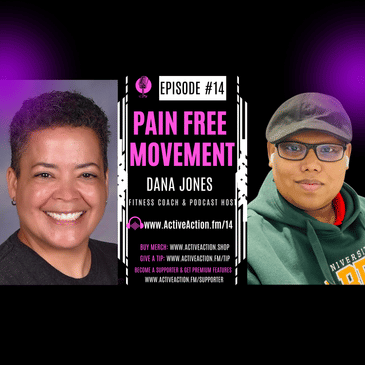

In this episode I interviewed Dana Jones, a fitness coach and host of the “Pain-Free Athlete” podcast. Dana shares insights on pain-free movement, and explains how simple things—like good ankle movement and core strength—can affect our ability to move without pain or discomfort. She also discusses the importance of the mind-body connection in healing, explaining how emotions and stress can amplify or trigger chronic pain. Whether you’re a seasoned athlete or simply looking to stay healthy as you age, Dana’s practical advice on strength training, active recovery, and daily habits will help you achieve a more active, pain-free life.
What You’ll Learn:
- Why emotions, stress, and mindset play a crucial role in chronic pain
- How Simple moves—like ankle rotations and walking backwards—to improve balance and reduce injury
- How building functional core and muscle strength supports pain-free movement
- Identifying everyday signs of imbalance (like stiff ankles or weak hips)
- How gentle movements and simple exercises can heal faster after injuries or surgeries
- How nutrition, self-awareness, and stress management contribute to long-term, pain-free living
Be sure to check the webpage of Dana Jones at the Active Action Podcast Website to learn more about Clifton’s work, his foundation, and ways to connect with him.
Listen to and follow my podcast for new content every week:
Spotify | Amazon Music | Apple Podcast | Youtube | RSS | Website
Become a supporter! Access premium contents and exclusive features & discounts: www.activeaction.fm/supporter
Buy Active Action Merchandise at a low price: www.activeaction.shop
Advertise at Active Action Podcast: www.activeaction.fm/advertise
Be my Friend:
Facebook Page: @ActiveActionPodcast
Personal Facebook Page: @Dr.Nazif
Instagram: ActiveActionPodcast
Request to be a guest using this FORM.
Support the podcast, buy us a coffee: www.activeaction.fm/tip
00:00:00
Welcome everyone to back again another episode in the Active Action Podcast.
00:00:05
Your host Dr. Nazib back again another episode where we will discuss today a medical aspect pain-free movement.
00:00:14
Today, we have a wonderful guest with us, but before introducing her
00:00:19
to you, I just wanted to like really quickly take a moment to
00:00:24
appreciate opportunity that you have provided me to
00:00:28
come in front of you every week and
00:00:31
discuss a topic that will inspire you to stay active and take action.
00:00:36
And that is our motto of the Active Action Podcast and we really hope we can do that through every episode.
00:00:42
I really also want to thank you to all my dear audiences for sticking up with us and
00:00:49
having been so engaged like we have seen your feedback. We constantly see like our
00:00:55
social media numbers like going up and the views are going up as well and really
00:01:01
helpful and we really feel supported when we see that it really helps us motivates me to
00:01:07
create new content. Thank you so much for the support and without further ado, I'll be
00:01:13
introducing my guest. Good evening, Dana. How are you doing?
00:01:18
I'm doing well.
00:01:19
And your audience as I mentioned for today's podcast,
00:01:23
our topic is pain-free movement and we have today with us
00:01:28
Dana Jones. She's a fitness coach and also the host of the Pain-Free Athlete Podcast.
00:01:35
Thank you so much, Dana, for your time and also for agreeing to share
00:01:40
some words of wisdom with our audiences. I'm sure like they will take some valuable advice and inspiration from the conversation that we all have today. Please
00:01:48
introduce yourself to our audience. Hi everyone. My name is Dana Jones and I'm a fitness coach and also podcast host.
00:01:57
And I got into all of this. I've been an athlete all my life and unfortunately probably around this
00:02:05
age of eight, I started suffering from migraines and it just became a thing. Like it was just a part of who I was and it was annoying and
00:02:14
at the time I had no idea what the cause was. Everybody had different ideas of, oh you ate chocolate or you had caffeine or you did whatever the things are that you do.
00:02:25
And so I would avoid a lot of things, but I just muscled through it and it wasn't until
00:02:31
probably my late 40s that I had a bad run where I went 15 months with a migraine every day.
00:02:41
It was crazy and I just didn't know what to do and it was during COVID and so I
00:02:47
found Dr. Sarno's mind body prescription book and I read it and then I realized that a lot of the pain that I have in my body
00:02:56
originated from a lot of repressed emotions and there's certain behavioral or personality
00:03:03
characteristics for somebody who suffers from chronic pain. So as a result of that, I
00:03:08
I wouldn't say necessarily cured myself, but I pretty much cured about 95% of my chronic pain
00:03:15
and so I felt like I needed to come and tell other people about it. So that's why I started the podcast and
00:03:22
now I'm just getting out there and I want other people to have the information because nobody should wait 43 years to get healthy
00:03:29
and pain free and there's other factors to why athletes suffer from pain and I know a little something about that.
00:03:36
So I thought I would share my story. Thank you so much, Dana, for sharing that story. I can coordinate because I have
00:03:43
several family members who actually did suffer from migraine and still are and I know the pain of migraine is intense. There is in pain language
00:03:53
no easy way to describe it and I know like when a migraine attack happens, it's a very painful condition. The person going through it
00:04:01
suffers a lot and one thing I've seen though and this pain doesn't subside and it doesn't go away with time. It like stays and it
00:04:10
occurs randomly, but I haven't seen like that going away and I know many people and many people around the world
00:04:17
and my audiences as well, they have suffered pain in one way or other. So I am really glad that we are talking about this topic today.
00:04:24
Maybe you can share some of your words of wisdom to how to reduce pain or how to take what actions to minimize that.
00:04:32
So before I bring to that topic more, I just wanted to talk to you a bit about the topic for today's podcast. What do you understand like
00:04:42
pain free movement or how do you define that? So pain free movement or at least my definition
00:04:48
is very different than what I talked about in terms of my chronic pain. So when you have a chronic pain condition,
00:04:54
that's something that you definitely need to go to a doctor and make sure that you
00:04:59
figure out what's going on and whether or not there's something that can be done. Usually when you know if it's a mind body
00:05:06
pain condition is when they say we've done all the tests and there's nothing there and then you go, oh, okay.
00:05:12
And then that's when you start doing the work. For those of you who are suffering from intermittent pain
00:05:19
or pain based off of could be repetitive use or any of that thing,
00:05:23
what I see as pain free movement is that your body is moving in perfect alignment.
00:05:29
That is for you. Sometimes we'll go to a shoe store and they say, oh, you need this shoe for this and oh, your knee is out
00:05:37
and it should be facing forward and you make these adjustments and then of course they create more pain because your body's used to moving
00:05:44
how it needs to move. So everybody's knee tracks differently, everybody's hips track differently, and it's whether or not it's actually causing you discomfort is
00:05:53
the need for concern. You should have mobility and not just flexibility. As an athlete growing up, I had
00:06:00
crazy flexibility. I could put my
00:06:02
leg behind my head and all that kind of stuff and it really wasn't about that because when I would get injured, pull a hamstring or something,
00:06:11
I wasn't able to stretch out the hamstring or do the things for the hamstring at the time because I was so flexible
00:06:18
that you're going to have to wrap my leg around my head for me to actually feel
00:06:22
some relief in that muscle and of course now I understand that mobility is really important.
00:06:28
How joints move and whether or not they move within their plane of existence. Strength plays a part in being pain free
00:06:37
and there are several guests that I've had that talked about strength training as the foundation for all athletic movement
00:06:44
and that without it, you're going to get hurt or you're not going to be able to perform to your potential and then
00:06:51
there's that mind body piece that I always like to stick in is really about how do you settle down?
00:06:58
How do you come back to yourself? How do you care for yourself in a manner that
00:07:03
allows you to be a complete athlete? What are the mental aspects of it? How are you tuning into your body? Are you worrying about overexertion? Do you feel
00:07:13
there's just no, also a triathlete and we have a lot of athletes that are going to be in the same situation
00:07:19
and there's just no, also a triathlete and we have a tendency of being a little obsessive and so mindfulness goes out the window and you're obsessive and you're like I have to get this workout in and that kind of thing because
00:07:31
when you're not doing those things, you're definitely increasing your risk for injury.
00:07:35
I wanted to touch a bit on a point that you mentioned like athletes do suffer or get injured, they suffer pain.
00:07:42
From your experience, there is like a myth or there is understanding that if major like injury occurs or if like major traumatic event occurs during performing
00:07:54
other sport or athletics that the carrier of the athlete actually like dies. Do you think that is true at all?
00:08:02
Repeat that last part again. The carrier of the athlete like ends, it dies, that carrier is no longer but do you feel that is accurate?
00:08:09
I don't know, people are funny and it's really, I think it's hard for us to deal with injury.
00:08:16
People don't, sometimes it becomes your entire existence and knowing how to make the transition is a challenge.
00:08:26
You just have to probably put your faith in the right people to help support you through certain transitions and it even comes down to
00:08:35
I know for me as an athlete, I was a college softball player and when I graduated, that was a death.
00:08:43
That was really hard for me because all of a sudden I had to make this transition as Dana Jones, college softball player to Dana Jones employee or whatever.
00:08:54
There's so many things that were part of my character like my days were so like hyper scheduled.
00:09:03
Because I was told when to eat, when to work out, when to play, all those things and then all of a sudden all that structure was gone.
00:09:13
I was left to my own devices and that was really a hard time. I think for when athletes get injured, those things happen too as well.
00:09:22
There's isolation, there's a depression, there's all not good things that occur on top of the fact that depending on the injury,
00:09:32
there's medication that's involved that could be addictive and there's also that urge to want to get back to it because you are feeling all those things and you don't want to lose your purpose.
00:09:45
I understand even from my sake of understanding, I really appreciate that perspective.
00:09:50
It must be really difficult for athletes to go through the transition or even just to think that I used to be one thing and the next day I'm not.
00:10:00
It's just because it's not complexly related to a topic but I have been following a YouTuber who did a lot of stunts with road bikes.
00:10:09
I know his career stopped at a very early stage I think when he was around 25 and what would be a very promising career.
00:10:18
So I really got hurt seeing that. I want to ask you again coming back to the topic that why do you think pain free movement is essential for an overall health?
00:10:29
I just feel like as a lot of people age, there's things that you can ignore.
00:10:35
As a young person you're like, oh my elbow hurts when I do this and so I'll just ice it and it will be okay.
00:10:43
And if you go back to the core understanding of like strength training and mobility and all the stuff you need, that allows you to look differently.
00:10:56
And the example I always have is my grandmother and my grandmother was not very athletic.
00:11:02
And I recall, I was in my teens when she was probably in her 60s, I thought she was 90 years old because she just looked, she was stooped.
00:11:13
She had no muscle. Like I remember one time I grabbed her arm to help her somewhere and it's like I could touch her bone because there was just no muscle density at all.
00:11:22
And she just looked so old and I'm almost to the age where my grandmother was because I'm 55 and I don't look like my grandmother.
00:11:34
How does that help people overall is like one, longevity.
00:11:38
Right. You hear about Peter Atiyah and everybody talking about the things that you need to do to really be able to exist.
00:11:46
And if you are being able to participate in things a lot longer, then that's going to keep your heart healthy.
00:11:55
It's going to keep your bone density up. All the things that make you look incredibly old.
00:12:01
And of course, overall, it's those people, because I think my grandmother was born in, I want to say 1911 or something like that, 1915, somewhere in there.
00:12:10
And she lived a very hard life and we haven't even talked about nutrition. I imagine her nutrition was not very good because she was a kid during the depression.
00:12:21
And so they got the food when they got the food and vegetables were not available and all those things.
00:12:28
So adding in the lifting and the being mindful about your movement and then adding in nutrition, I think is going to allow us to live a lot healthier and a lot longer than my poor grandmother.
00:12:43
Although she did live until she was like 85. It's again, I don't know what how well her life was because of the fact that she wasn't able to move the way that she wanted to move.
00:12:53
And it was sad watching her.
00:12:54
While sharing this story, you touched a bit about age and pain. So I know there is a myth regarding pain associated with age and also pain associated with being doing exercise a lot.
00:13:07
So I just want to talk to you about this myth a bit. So what is like your understanding about the myth of the being pain coming up automatically when you age or when you do a lot of exercise or these kinds of things?
00:13:21
Do you really think these are associated?
00:13:24
There's always being an athlete, there's always the myths. And one of the crazy ones is right, no pain, no gain, which is a bunch of bullshit.
00:13:33
Excuse me. Sorry.
00:13:34
But it's you should never push yourself beyond and to the point where it's causing you enough discomfort for you to have to prove something to anybody.
00:13:43
But there's also as I'm coaching older clients, I'm hearing these things that they're hearing from their doctors.
00:13:49
Oh, the reason why your knee hurts is because your bone on bone or the reason of this is happening is because you're getting old or so there's a lot of I want to say medical model myths that are pushed on people to have explanations for their pain.
00:14:07
And like I have a client that has no cartilage in their knee and they were in pain, but they started doing some exercises and the proper exercises to build up all the muscle surrounding it and the pain went away.
00:14:20
And the reality is the most cartilage that you'll have in between your bones is when you're an infant because you haven't put any pressure on any of your joints.
00:14:30
And then as we age, you're eventually going to get bone on bone because that's what happens. Cartilage wears away through movement.
00:14:38
And as long as you're moving, then that's going to happen.
00:14:41
Whether or not there's pain there is really up to you.
00:14:45
And it's also up to the mindset, right?
00:14:47
I want to say that pain is a real thing, right?
00:14:50
And that's one of the things that in the chronic pain community, sometimes people will misinterpret and say, oh, when you say that pain is a mind body condition that you're saying it's in my head.
00:15:02
And the reality is it's not in your head because what your brain interprets, your body will feel.
00:15:09
And so pain is very real.
00:15:12
You can make yourself hurt as just there was a study where they had two different people, a guy got put a nail through his boot and he was screaming and freaking out because he thought he was going to die because of the nails in his boot.
00:15:26
He gets to the ER, they pull off the shoe and the nail, it went between his toes, but he just saw the vision of it and he absolutely lost his mind.
00:15:36
Now we could say, oh yeah, that's crazy.
00:15:38
But he was feeling actual pain.
00:15:40
The medical staff was responding to him as if he was somebody who was injured because he felt that pain.
00:15:46
There's been other cases where people have done, it always seems to be around construction equipment, which I always think is interesting, where they've taken a nail gun to the head or whatever and they experience no pain because they don't even know it's there.
00:15:58
And it's not until somebody highlights that it's there that they're like, holy crap, that really hurt.
00:16:03
Just, I think understanding that there is this conception now that, or perception that you have to experience pain because you're older or that it's just normal.
00:16:14
And it's not.
00:16:15
There are ways to reverse pain and there are different programs out there.
00:16:20
And again, you have to find the program that's for you, but there are strength programs that will help reduce and eliminate pain.
00:16:26
Now, if you have a injury, a torn, whatever it is, some do require surgery and that will relieve your pain.
00:16:35
But you just, again, that's where that medical professional comes in and you really should consult with your doctor and physical therapist and all the people that are on your care team.
00:16:45
An important thing I need to touch a bit on is you did talk about the connection of mind and body when it comes to pain.
00:16:53
So can I just ask you, what do you think, how does that mind body connection actually helps with pain?
00:16:59
Helps or enhances.
00:17:01
And I like in my own personal experience, and that's all I can really give you because I'm not in those medical studies that are talking about this,
00:17:10
is that when I was experiencing the most pain was when I was the most disconnected from my body.
00:17:18
And that is really where everything is that because when you start suffering from pain, there's this you wanted to distance yourself and from regular conversation, right?
00:17:31
You're like, oh, I have a headache, so I'm going to take some Advil because I want to continue doing what I'm doing and I want the pain in my head to go away.
00:17:37
That's fine.
00:17:39
But when you're getting down the line and it's something that's chronic or whatever, that detachment or the need for detachment really brings the pain to the forefront
00:17:51
because you're like, I don't want to know that it's here.
00:17:53
My toe doesn't hurt. My toe doesn't hurt.
00:17:55
And the more you talk about your toe, that your toe hurts and you're with it.
00:17:59
And when you start really diving into why something hurts or what's the reasoning behind it.
00:18:08
And again, your toe could hurt because you kicked your dresser yesterday when you were barefoot.
00:18:12
So of course your toe is going to hurt.
00:18:14
But if your pain comes out of nowhere and it's there and it's getting your attention, now you need to think about what are things that are going on right now.
00:18:25
So, for instance, a lot of people will be at work and they'll notice if they have a stressful day, their back hurts.
00:18:32
Is it because you have a slipped disc or you have this or you have that or is it because you're stressed because you have a timeline and whatever?
00:18:40
For me, a lot of it, like I said, was about that not really dealing with emotions.
00:18:47
I was raised in the idea of to be seen and not heard kind of thing.
00:18:51
So my opinion didn't matter for a lot of stuff, especially as a young child.
00:18:56
Not that I'm saying that young children should be running free and doing stuff.
00:19:00
I never had the ability to speak up for myself, or at least I thought I didn't have the ability.
00:19:06
So then my response was to stuff it.
00:19:10
And then I was in the military and you have people screaming in your face and you can't scream back.
00:19:14
So you stuff it.
00:19:15
And so that became a pattern for me is to stuff my response to a lot of moments that could possibly anger me or make me sad or frustrated or any of those things.
00:19:26
And so then it just became a default setting for me is to stuff my stuff, essentially.
00:19:32
And your body says, okay, we'll allow you to stuff that one.
00:19:36
Okay, you could stuff that one.
00:19:38
But after a while it goes, we're over this.
00:19:40
We only have the jar is pretty full.
00:19:42
So we're going to give you something to get your attention.
00:19:45
That's, oh, I'm going to give you knee pain.
00:19:47
I'm going to give you hip pain.
00:19:48
Okay.
00:19:48
I'm going to make your head hurt.
00:19:50
Oh, your head, you're not responding to head pain.
00:19:52
So now we're going to add something else.
00:19:53
And so then it starts to add up.
00:19:56
A lot of times when you're dealing with somebody who especially has chronic pain conditions, you'll notice that it's not one thing, that it's multiple things.
00:20:06
And on top of it, to add in the mind body piece, there's usually a personality type.
00:20:11
And people who suffer from chronic pain are typically people that are type A personality.
00:20:17
Those are your people pleasers.
00:20:18
They really just want to do everything and want to control everything.
00:20:22
And we can't control anything aside from your perception of events.
00:20:28
And that creates a lot of frustration and then frustration leads, unfortunately, to a lot of pain.
00:20:34
So how do you reverse that is you start to ask yourself questions and you start to do different things.
00:20:43
I know meditation is very frustrating for a lot of people because they think that they have to sit in place and follow their breath and don't want to have monkey mind and all those things.
00:20:52
There's other ways to do meditation.
00:20:53
You could do it walking meditations.
00:20:56
You can do observations of sounds in your room.
00:20:59
There's all kinds of things or talk to your pain.
00:21:02
I have my own personal thing was journaling and we tease and we call it rage on the page.
00:21:08
That was a good way because I found out that if I mad at my boss and I write down a bunch of stuff about how I'm so angry and everything else, I'm able to get the frustration out.
00:21:19
And then, of course, the resolution would come in a clear manner after I was able to get past the initial anger, frustration or whatever I was feeling.
00:21:28
So that's how as an athlete, you need to deal with that.
00:21:32
If you're trying to hit a shot and it's not working, then when you're getting frustrated and you're not seeing the result, then that's one way of sitting back and having what am I feeling?
00:21:43
Why is this result so important?
00:21:45
Because a lot of times it's really not important, but you're just making it important at the time.
00:21:49
I really feel the mind and the body is like, indeed, like, interacted with pain.
00:21:54
And it's like your perception of pain.
00:21:56
And when you are in pain, how would you train your mind to be that?
00:22:01
And that is another thing that how your body reacts to your mind.
00:22:06
I think that as humans, the pain is inevitable.
00:22:10
It will come, but it's also important how we train our mind to bear with that.
00:22:16
You also touched about beating out the frustrations and angers.
00:22:20
And that is also a pain like frustration and anger is causing you pain.
00:22:23
So how do you get relieved of that?
00:22:26
One good thing you mentioned what you did was journaling.
00:22:29
I feel journaling is also very effective.
00:22:32
There are many other ways you can relieve your pain.
00:22:35
An important bit is self-realization to recognize how you can actually relieve the pain.
00:22:42
What actually works for you?
00:22:43
Think of that and really like to just try it out.
00:22:46
It might be doing some exercises can help your mind taking off from things,
00:22:52
doing some activities, gardening, reading books, writing a journal, playing some games in videos.
00:22:58
But whatever you want to do and you can get the frustration or anger out.
00:23:03
I think it's very important because having a healthy mind doesn't hurt at all to relieve the pain.
00:23:09
So I could ask you a bit about, can I share with my audience,
00:23:13
what are the signs of dysfunctional movement?
00:23:16
I think I'll give it.
00:23:18
So I have a client and I haven't seen her in a while.
00:23:21
And so I was on Facebook one day and she fell.
00:23:25
And she posted about her that she fell and whatever.
00:23:29
And I said, you need to come see me.
00:23:32
And she's, oh no, I'm hurt. I can't come see you.
00:23:34
I said, oh no, you need to come see me.
00:23:36
And so she comes to see me and we sit down and we're talking about this.
00:23:40
I said, tell me what happened.
00:23:41
She goes to the sidewalk, did this and whatever.
00:23:44
And I got caught up in it and then I just ended up falling.
00:23:47
And she felt pretty good.
00:23:48
Like she landed.
00:23:49
It was like knees, hands, face, which is never a good fall.
00:23:53
No.
00:23:54
And so of course it was like, I'm older.
00:23:58
Now I'm my mom.
00:23:59
I'm falling and whatever.
00:24:01
And I said, no, that's all that's bunk.
00:24:05
That's not true.
00:24:06
And she's, what's going on?
00:24:07
I said, and I had her do a few exercises and I said,
00:24:11
the reason why you fell is because your foot isn't moving
00:24:14
and ankle mobility isn't there.
00:24:16
And she says, what are you talking about?
00:24:17
And I had her do an exercise and showed her that her ankle wasn't moving
00:24:21
really at all.
00:24:22
And she goes, I've had plantar fasciitis and whatever,
00:24:25
and all this other stuff.
00:24:26
And so we started to detect essentially like what was going on.
00:24:31
And essentially what was happening was that her hip flexors were weak.
00:24:35
And as a result of her hip flexors being weak,
00:24:38
she wasn't lifting her knee when she was walking.
00:24:41
And then with the lack of ankle mobility, she landed funny
00:24:46
because something, the terrain changed.
00:24:49
So she landed funny and then got caught and then fell down.
00:24:54
And so we moved through all that and then gave her a few exercises,
00:25:00
gave her some homework for doing water fitness and other things
00:25:04
because she's not a huge fan of working out.
00:25:07
That's one of the things is that you have to find activities that
00:25:10
are fun for you and that allow you to get a workout
00:25:14
but don't feel like a workout because not everybody has time.
00:25:17
But I think if it's something you enjoy, you make time for things that you enjoy.
00:25:22
But that was an example of movement.
00:25:26
It came from her having plantar fasciitis.
00:25:29
Now doing all those exercises, plantar fasciitis went away.
00:25:33
And so now she's out and she's because she was walking her dog
00:25:38
and she wasn't walking her dog because she had the plantar fasciitis.
00:25:41
So there was a lot of things that led to that dysfunction.
00:25:46
And it was culminating, right?
00:25:48
All these different events that lead to this.
00:25:51
Fortunately, she didn't get hurt too badly, but that's when people
00:25:56
usually when somebody gets hurt is when they realize that
00:26:00
something isn't working properly, right?
00:26:02
Or you get injured and it's a weird injury.
00:26:04
It's never like a tear or something like that.
00:26:07
It's always something that is more of a repetitive or a fall.
00:26:12
I always remember Peter Goskiew talking about one of his clients
00:26:16
and Peter Goskiew is a movement specialist
00:26:19
and he's located in Southern California, San Diego area.
00:26:23
And he had a client who came in because she broke her wrist.
00:26:27
And he did the same thing and he asked her, he said,
00:26:29
how did you break your wrist?
00:26:30
She said, there's a magazine on the floor.
00:26:32
I didn't see it.
00:26:33
And I stepped on it and I slipped and I fell.
00:26:36
And I braced myself and whatever.
00:26:38
And so he talks about the idea that if she had core actual core strength,
00:26:43
meaning not abdominal strength, but core strength,
00:26:46
meaning knee caps to shoulders strength,
00:26:50
she would have slipped and just slid a little bit,
00:26:54
but then regained her balance.
00:26:56
But because she did not have core strength,
00:26:59
she ended up slipping and taking a hard fall.
00:27:02
So that's where that dysfunction comes in.
00:27:06
That's why you do all exercises.
00:27:09
Like you look at the guys that go to the gym and sorry,
00:27:12
it's mostly guys who are like, I'm going to bench, I'm going to squat,
00:27:15
and then I'm going to deadlift and I'm going to lead.
00:27:18
And they don't do anything else.
00:27:20
And they get hurt as well because of the fact that they're not working on their core strength.
00:27:24
They're not working on their twisting.
00:27:26
They're not working on using your back, your spine,
00:27:31
the way it's supposed to articulate.
00:27:33
We hear, especially in lifting heavy, how the back needs to be tight
00:27:37
and it needs to be flat for the movement.
00:27:39
And you're putting inordinate strain on your lower back.
00:27:43
And it's like our spine has vertebra for a reason.
00:27:47
And it's because you're supposed to use every one of those to make movement.
00:27:52
And so that's why you are supposed to do exercises that work all the way up your back.
00:27:59
And again, having that strength will allow you to avoid silly things like falling,
00:28:05
or not that they're silly, but you know what I'm saying,
00:28:07
something that's preventable is probably something.
00:28:11
Thank you so much for that answer, Dana.
00:28:13
And this functional movement, I can reason it because I had one of my friends
00:28:18
who used to go to the gym and do a very set pieces of exercise,
00:28:23
mostly like dead lifting, weight lifting, that kind of thing.
00:28:26
But it actually led to devastating consequences for him later on.
00:28:31
But we need to understand and recognize where things are occurring,
00:28:35
what habits are triggering.
00:28:37
It's very important that how we lead our life,
00:28:39
what type of trainings or what type of exercise we do, how our lifestyle is.
00:28:44
But we have to be really mindful and cognizant of those.
00:28:48
Can I ask you to share some practical strategies for pain-free movement?
00:28:55
Ankle turns.
00:28:57
Oh, that's interesting.
00:29:00
All of our movement comes with starts at our base and your feet.
00:29:06
And having that mobility, my client wouldn't have fallen
00:29:09
if she had that mobility in her ankles.
00:29:12
And so something simple that people can do is ankle turns,
00:29:17
turn to the left, turn to the right, point and flex.
00:29:22
That is probably something you could do while you're watching TV.
00:29:27
You could do it as part of your warm-up for your workout, that kind of stuff.
00:29:32
Obviously, all core work.
00:29:33
So things where you're twisting and moving and definitely not with planted feet.
00:29:40
So as you're twisting, your hips are moving with you
00:29:42
so that you don't create other issues.
00:29:45
And then just making sure that the movements that you're doing
00:29:49
are within the structural range.
00:29:53
So for instance, a lot of people will do shoulder presses
00:29:57
and they'll do it in a military press manner,
00:29:59
meaning that their hands are behind their shoulders and they push up.
00:30:03
And when you're about to straighten up your elbows,
00:30:09
you're pushing the bounds of the capsule in which your shoulder's in.
00:30:14
And making sure the movement stays within your range
00:30:18
and you feel comfortable.
00:30:19
Anytime you feel a strain or something like that,
00:30:21
you never want to do that.
00:30:24
So it's like looking at that stuff.
00:30:26
Ben Patrick and his pain-free movement stuff is great.
00:30:31
I don't even know why I can't remember his stuff, right?
00:30:34
It's ATG.
00:30:35
One of the biggest things that I have my clients do
00:30:37
as a result of some of the stuff he has is walking backwards.
00:30:41
Because that really works on ankle mobility
00:30:44
and that stability that your body needs to keep you going.
00:30:47
And so that's something that I've implemented.
00:30:49
But those are a couple of things.
00:30:51
But if you're not doing Pilates or yoga,
00:30:54
you need to at least one day a week,
00:30:57
make sure you implement that into your program.
00:31:00
Again, if you're somebody who's into water,
00:31:04
water fitness is a great activity to do.
00:31:06
You may want to complain,
00:31:08
I don't want to be out there with all those little ladies
00:31:10
bobbing up and down.
00:31:12
But I will tell you, they all have core.
00:31:14
And you'll find out real fast when you're in that water
00:31:18
if you have core, because you may have ground core,
00:31:20
but there's nothing like doing a crunch in the water
00:31:23
and not drowning.
00:31:25
Those are the kind of things that you'll find out really fast.
00:31:28
Water is the great equalizer for a lot of activities.
00:31:32
And those are some of the things that you could do.
00:31:34
But really at its core, like what you need to do
00:31:38
is definitely keep your joints mobile
00:31:42
and working within their range,
00:31:43
doing something that you enjoy
00:31:46
and making sure that it's something
00:31:48
that you're willing to come back to
00:31:50
so that you don't get bored and give it up.
00:31:53
And just stay active.
00:31:56
Go for a walk, do the things,
00:31:58
find friends to go do stuff with
00:31:59
so that you're more apt to move.
00:32:04
I really appreciate you sharing those
00:32:07
very practical strategies for pain-free movement.
00:32:10
Can I take this opportunity
00:32:11
to ask you another follow-up question?
00:32:14
We know when someone is suffering from pain,
00:32:18
they need to, many actually struggle to recover from that.
00:32:22
But can I just ask you, for the benefit of my audiences
00:32:25
again, to share some active recovery tips
00:32:28
from your experience?
00:32:29
Sure.
00:32:30
I've had post-surgical clients that have come in
00:32:34
and a lot of times they are just like,
00:32:36
I'm in a cast, I can't come.
00:32:37
And I was like, of course you can.
00:32:39
Because you could sit in a chair and you can do things.
00:32:41
And the number one benefit to any body
00:32:45
when you're recovering is to actually move.
00:32:49
And if you're in a chair and you're lifting weights
00:32:53
or doing whatever you need to do,
00:32:55
you could still do that, right?
00:32:56
There's chair yoga, there's all that kind of stuff.
00:32:58
But I think in the past our recovery idea was,
00:33:02
I had surgery and I'll use myself as an example.
00:33:06
I had knee surgery and my doctor said,
00:33:08
okay, you're at a commission for however long,
00:33:11
six weeks it takes to fix it and go home and lay down.
00:33:15
And so I, at the time, thank goodness,
00:33:19
I was a college athlete, so I was a little bit more
00:33:21
in tune with what was going on.
00:33:23
I started doing isometric exercises and specifically holds.
00:33:27
So yes, my knee was immobilized, but I'm squeezing my thigh
00:33:32
and I'm continuing to build strength because the reality
00:33:36
is that when a scalpel touches your skin,
00:33:40
your muscles will atrophy, like instantly.
00:33:44
You'll see it, somebody who's had knee surgery,
00:33:46
you'll look at them and the non-surgical leg
00:33:49
will be a certain size and then the surgical leg
00:33:52
will just be probably an inch or two smaller,
00:33:55
just because of the actual activity of having that surgery.
00:34:00
And so the way that you can do that is one,
00:34:02
you should, if you're having a surgery,
00:34:04
you should probably study.
00:34:06
And what I mean is that you do exercises beforehand
00:34:10
to get everything strong surrounding the area
00:34:14
that you're getting operated on.
00:34:15
So if you're doing a knee surgery,
00:34:18
you're gonna be doing pushups,
00:34:19
you're gonna be doing all the stuff
00:34:21
because if you're gonna be on crutches,
00:34:23
you need to be able to be strong.
00:34:25
You're doing your ab exercises,
00:34:26
you're making sure your other leg is working
00:34:29
and even the surgical leg, you can do leg lifts,
00:34:32
you can do isometric exercises.
00:34:35
There's little things that you can do to study.
00:34:37
And then post-surgical, the isometric is the easiest thing.
00:34:41
Now, thank goodness, we're a lot smarter.
00:34:43
So now, like when you have a surgery,
00:34:46
they're having you walk, right?
00:34:48
Think about it.
00:34:49
If you've gone for a family member who's had surgery,
00:34:52
they're like, have you done your lap today?
00:34:54
Because we know that blood flow encourages healing
00:34:58
and they're getting better surgical outcomes
00:35:00
from people moving and not just laying there immobile
00:35:03
for whatever period of time it is.
00:35:06
Getting out and walking,
00:35:07
if it's something lower leg where it's a severe injury,
00:35:10
like I have a friend who he plays football,
00:35:14
one of the players fell back on him
00:35:16
and tore all the ligaments in his knee.
00:35:19
But he can use a hand cycle to make sure
00:35:22
that the upper body is still moving
00:35:24
and still getting a little cardio workout
00:35:26
while he's waiting for that leg to recover.
00:35:28
So the biggest thing is that when you're doing something,
00:35:31
move it as much as you can,
00:35:34
just because you're going to get all those good blood cells
00:35:38
heading in the right direction
00:35:39
and allow you to get back at it a lot faster.
00:35:42
I would ask my dear audience,
00:35:44
if you do have any questions for our guest today,
00:35:47
Dana Jones or you to know a bit more about our guest,
00:35:51
you can do that by going to our website,
00:35:54
activation.fm and there is a webpage
00:35:57
dedicated to Dana Jones.
00:35:59
I put the link in the video,
00:36:01
it's activation.fm slash persons slash Dana dash Jones.
00:36:06
So if you have any questions,
00:36:08
feel free to ask Dana and also don't forget to like,
00:36:12
I'll tune into our podcast as well.
00:36:14
So just moving on to that Dana,
00:36:16
I wanted to ask you a bit,
00:36:18
what do you actually discuss in the Pain Free Athlete Podcast
00:36:22
if you can let our audiences know?
00:36:24
I have a fun time.
00:36:27
I love hosting podcasts.
00:36:29
I love talking to people,
00:36:30
bring in nutrition experts.
00:36:32
I bring in athletes who have recovered from chronic pain.
00:36:36
I bring in, I had a hypnotherapist on there
00:36:39
and we talked about how that mind body piece is good
00:36:43
for certain circumstances,
00:36:45
for people who are struggling with either chronic pain
00:36:48
or even in athletic performance.
00:36:50
We bring in, I had a mind coach that worked with athletes.
00:36:54
I just try to find people that I'm hearing from my audience
00:37:00
that they're interested in hearing about.
00:37:02
Right now the focus is a lot on nutrition
00:37:06
because it's that time of year.
00:37:08
We're in January and people really wanna change
00:37:11
their eating habits and get ready for the spring
00:37:14
and so I just had a guest on that talked about
00:37:16
functional nutrition in terms of how it deals
00:37:18
with athletic performance.
00:37:20
So I really have the opportunity to talk to a lot
00:37:22
of different people and I'm truly grateful for that
00:37:26
because I'm learning a lot and unfortunately,
00:37:29
I didn't have this information when I first started
00:37:32
to get into athletics and my nutrition was crap
00:37:35
and I'm sure that had a lot to do.
00:37:37
My performance was definitely affected by it
00:37:40
and so if you're an athlete and you want to learn
00:37:43
how to create longevity in your athletic career,
00:37:47
it's always good to look around and listen to experts
00:37:51
talk about what they know.
00:37:53
I really appreciate your time for today
00:37:55
and for sharing your very wonderful words
00:37:58
of wisdom with my audiences and inspiring them
00:38:01
to stay active and take action.
00:38:03
And if you have any last suggestions or last words per se
00:38:06
for the audience, it's all quite welcome.
00:38:08
Thank you so much for having me.
00:38:09
I appreciate your time and like I said,
00:38:12
I love talking to people and always,
00:38:15
yeah, you just gotta keep moving.
00:38:17
Dear listeners, we were talking to our wonderful guest,
00:38:20
Donna Jones this evening.
00:38:22
I really hope you gained some very useful tips
00:38:26
and perspective and also got to learn a bit
00:38:29
about pain-free movement.
00:38:30
She really did indeed came across some very good points
00:38:34
regarding strength training, active recovery tips.
00:38:37
So I really encourage you, even if you're a potential athlete
00:38:40
or if you're looking for fitness related tips
00:38:44
to visit her podcast, the Pain-Free Athlete Podcast.
00:38:48
And again, once again, thank you so much
00:38:50
for tuning into this episode.
00:38:52
I would really appreciate if you could kindly leave a review
00:38:55
or rate our podcast in Spotify or Amazon Music
00:38:59
or the Apple Podcast.
00:39:01
And also if you do find value to our podcast,
00:39:04
I really would really appreciate your kind of support.
00:39:08
You can provide support to us by going to website
00:39:12
and donating in www.activeaction.fm slash donate.
00:39:17
Any generous support really helps me to create new episode
00:39:20
and just keep this production get rolling.
00:39:23
But I really appreciate your time
00:39:25
and I hope that we will be meeting you
00:39:27
in the next episode next week with another wonderful guest.
00:39:31
Take care and I urge you to everyone to take action
00:39:35
and stay active at this time.