
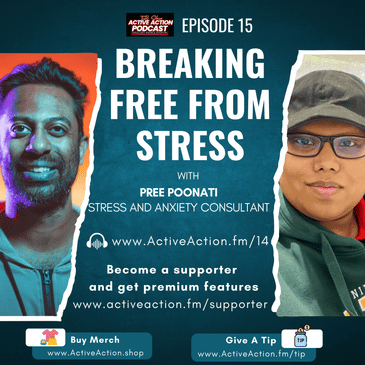

In this episode I interviewed Pree Poonati, a stress and anxiety consultant from the Art of Nirvana. Pri shares his journey from being an overwhelmed auditor at Ernst and Young to becoming a personal trainer and stress consultant. He offers valuable insights on recognizing and managing stress, differentiating between conscious and unconscious stress, and practical techniques for reducing stress daily. Pri introduces his 'Mojo' technique and discusses how adjusting expectations and shifting mindsets can help alleviate stress. Listeners will also learn about the pivotal role a coach plays in stress management and how to build healthy habits for a more fulfilled life.
What You’ll Learn:
- Pree’s transition from auditing to stress consulting and his personal burnout experience
- The difference between conscious and unconscious stress and how they impact health
- Practical strategies like the 'Mojo' technique for daily stress reduction
- The importance of setting realistic goals and building healthy routines
- How shifting your mindset can help manage and reduce stress
- The role of a stress coach in personalized stress management - Practical breathing techniques to regulate stress responses
- Tips for students and professionals on managing stress
Click Here to read a blog related to this episode.
Be sure to check the webpage of Pree's at the Active Action Podcast Website to learn more about his work, and ways to connect with him.
Listen to and follow my podcast for new content every week:
Spotify | Amazon Music | Apple Podcast | Youtube | RSS | Website
Become a supporter! Access premium contents and exclusive features & discounts: www.activeaction.fm/supporter
Buy Active Action Merchandise at a low price: www.activeaction.shop
Advertise at Active Action Podcast: www.activeaction.fm/advertise
Be my Friend:
Facebook Page: @ActiveActionPodcast
Instagram: ActiveActionPodcast
- [00:00:00] - Episode Highlights
Support the podcast, buy us a coffee: www.activeaction.fm/tip
00:00:00
I actually was an auditor for Ernst & Young in New York City in 13.
00:00:07
And I was working 80 to a hundred hours a week and I got pretty burnt out.
00:00:13
So after meditating for a little bit, I realized that I wanted to be in service.
00:00:18
And I moved to Austin, Texas and I became a personal trainer, a yoga teacher, a
00:00:23
meditation teacher, and a nutritionist.
00:00:26
Someday, one day ends up never day, you know?
00:00:30
So that's a, that's a typical pattern.
00:00:33
Instead of getting addicted to the outcome, get addicted to the pattern and get addicted
00:00:39
to the routine of doing the healthy habit.
00:00:43
Because if you get addicted to that, then the results will just come.
00:00:47
It's like being human is a suffer, right?
00:00:49
So you can choose to suffer if you want to, but how you can shift your
00:00:55
mindset and helping overcoming stresses, acknowledging it's like, Hey, I'm
00:01:00
stressed out right now, or this is a very stressful situation.
00:01:04
You're tuned into the Active Action Podcast.
00:01:07
Step into a world of engaging conversations with leading experts, where
00:01:11
every episode is your chance to learn, grow, and stay inspired.
00:01:15
Whether you're here to discover fresh insights or simply be entertained,
00:01:19
we've got you covered.
00:01:20
Visit ActiveActionPodcast.com to explore all episodes.
00:01:25
Welcome back to another episode of the Active Action Podcast.
00:01:28
It's me, Dr.
00:01:29
Nazif, back again with another exciting episode where we inspire you to stay active
00:01:37
and take actions.
00:01:38
I want to share a huge appreciation and thanks to all our dear listeners to keep
00:01:44
staying with us and to follow us and to listen to us and your feedback is really
00:01:49
valuable to improve our show and to bring your favorite guests.
00:01:53
Just really wanted to quickly remind that we do have launched our own merchandise,
00:01:59
the www.ActiveAction.shop.
00:02:03
We do have t-shirts, water bottles, and other goodies for you to check out.
00:02:07
Apart from that, I just want to remind that we did start a premium supporter
00:02:11
subscription model for our listeners.
00:02:14
If you want to learn more about personal and professional development, we have
00:02:17
amazing articles and blogs in our website.
00:02:20
And apart from that, our premium supporters also get other exclusives and perks.
00:02:26
Today, we have a very interesting topic with us and have a very knowledgeable
00:02:32
expert.
00:02:32
So without further ado, I want to introduce to you to Pree.
00:02:37
Good evening, Pree.
00:02:38
How are you doing this evening?
00:02:40
Hey, I'm doing well, Dr.
00:02:41
Nazif.
00:02:41
How are you doing?
00:02:43
I'm doing great.
00:02:43
Thank you so much for asking.
00:02:46
And today, dear listeners, we will be talking about breaking free from stress.
00:02:52
And we have our expert Pree Poonade.
00:02:55
So Pree Poonade is a stress and anxiety consultant of the art of Nirvana.
00:03:01
And today we're going to speak to you about stress, specifically how you can
00:03:07
overcome that, the process that you go through with our expert Pree.
00:03:12
So we just wanted to begin by asking Pree if you would like to share some
00:03:17
information about you with our listeners.
00:03:21
Yeah, absolutely.
00:03:22
Thanks for having me again, Dr.
00:03:24
Nazif.
00:03:25
As you mentioned earlier, my name is Pree Poonade, stress and anxiety
00:03:30
consultant, and you might be wondering, well, what is that?
00:03:33
Or how do people get into that?
00:03:35
And quick backstory is I actually was an auditor for Ernst & Young in New York
00:03:44
City in 13, and I was working 80 to a hundred hours a week and I got pretty
00:03:50
burnt out, really burnt out.
00:03:53
And I just wasn't happy with how my life was going.
00:03:56
So kind of had to sit and ask myself, it's like, okay, Pree, what do you
00:04:00
really want to do?
00:04:01
You know, it's like, what's going on here?
00:04:03
So after meditating for a little bit, I realized that I wanted to be in service.
00:04:08
And I moved to Austin, Texas and I became a personal trainer, a yoga
00:04:13
teacher, a meditation teacher and a nutritionist.
00:04:17
And I operated my own gym for about five years, shut it down actually
00:04:21
three months before COVID.
00:04:23
What I realized was that even people that were coming in gym were having
00:04:27
trouble really developing healthy habits and really getting through
00:04:32
routines. So I was like, you know what?
00:04:34
I don't really need the gym anymore to teach us.
00:04:37
I want to give people practical tools and tips that they can use to help live
00:04:41
a life of fulfillment by being consistent in terms of showing up with
00:04:47
the way that they want to live lives.
00:04:49
So that's kind of how we got here.
00:04:52
That's wonderful Pree and I'm really inspired to know that you had your own
00:04:57
gym and then you now impart your wisdom and knowledge, more personal
00:05:02
experience for your clients.
00:05:04
I wanted to ask you Pree, like from your perception, what do you think
00:05:08
strength lecture is?
00:05:09
How can you tell someone is in stress?
00:05:12
What is the indication that they are in stress and they would feel stress?
00:05:16
Yeah, that's a great question.
00:05:20
I think it varies for everybody, but to me, what stress means is you're
00:05:26
trying to accomplish something or you're trying to be somebody, but there
00:05:33
are obstacles that are coming in your way and you either keep running into
00:05:37
those obstacles over and over again, or once you hit an obstacle, you just
00:05:42
stop and not do anything and then just wait for another opportunity to come.
00:05:47
So stress is an indicator that, Hey, there's more improvement.
00:05:54
There's a level of growth that we still have to come and you're great with where
00:06:00
you're at, but there's always room for improvement exercise of trying to
00:06:04
improve is just going to make you mentally and physically stronger.
00:06:08
So that's my definition of stress.
00:06:13
So we do know stress is something that everyone feels at some point.
00:06:18
And there are things to understand, like what stress is and how to manage it.
00:06:23
Oftentimes people are not able to that actually overwhelm some more.
00:06:27
So I just want to ask you, what do you understand when we say the term
00:06:32
like unmanaged stress or stress that we cannot control?
00:06:35
Can you share some light on that?
00:06:38
Yeah.
00:06:39
So to me, there's two types of stress.
00:06:42
There's unconscious stress and there's conscious stress.
00:06:44
Conscious stress is the stress that you know is evident.
00:06:50
For example, if you're stuck in a traffic jam and you might be late for a meeting,
00:06:53
it's like you're experiencing stress.
00:06:55
Your heart rate might be elevated.
00:06:59
However, there's two things you can do.
00:07:01
You can continue to feel incoherent and just like out of rhythm, or you can be
00:07:09
like, you know what, there's really nothing I can do right now, except
00:07:12
maybe make a phone call and just see if I can just tune into this and accept it for
00:07:17
what it is and what lesson can I take from this experience?
00:07:21
Maybe it's to leave a little bit earlier or take another route.
00:07:25
Right?
00:07:25
So that's conscious stress.
00:07:27
Unconscious stress is stress that just nags us over and over again.
00:07:32
For example, like every time you go to the garage and if the garage is messy,
00:07:36
you know, you're thinking, I got to clean the garage.
00:07:38
I got to clean the garage.
00:07:39
And you think about that 30, 40, 50 times during the week or during a month.
00:07:44
That's clearly an indicator that's telling you it's like, this is important
00:07:48
for me to do because it's making me elicit some sort of emotion.
00:07:53
That is very helpful to know.
00:07:55
And I know when you mentioned about conscious stress and unconscious stress,
00:07:59
stress actually have a big impact on people's physical and mental well-being.
00:08:04
Can I ask you from your experience, how does unmanaged stress impact
00:08:08
physical and mental well-being?
00:08:10
Can you shed some light on that?
00:08:11
Yeah, absolutely.
00:08:14
So how it impacts physical well-being is we all have different levels or we all
00:08:23
have different responses to stress.
00:08:25
Some people eat unhealthy.
00:08:26
Some people might smoke.
00:08:27
Some people might drink.
00:08:29
Some people might engage into addictive behaviors and they're conscious of those
00:08:34
behaviors because they don't want to do it.
00:08:36
And for them engaging in that behavior is like, you know,
00:08:40
engaging in those behaviors is a short-term fix instead of a long-term solution.
00:08:45
So if that keeps happening, then the shame and the guilt that we feel
00:08:50
internally is just going to build up and build up and build up.
00:08:53
And then we just don't end up liking ourselves.
00:08:56
And this is where we tie into the mental.
00:08:58
We don't end up liking ourselves.
00:09:00
Then we just don't try and we don't show up the way we want to show up or we
00:09:04
might view ourselves as less than or failure or just in some extreme cases,
00:09:10
some people that don't want to be alive anymore.
00:09:12
So it's a clear indication that, Hey, there is some obstacles that are coming
00:09:20
and I can either avoid the obstacles or I can put myself in a position to try
00:09:24
to overcome and succeed these obstacles.
00:09:29
Thank you so much for explaining that.
00:09:32
I also wanted to like ask you, you know, like people when they're working on
00:09:36
something and when they're trying to achieve, you know, like people, most
00:09:40
oftenly when they cannot try something or cannot achieve something to their
00:09:44
work, they get stressed, they go into like anxiety and stuff.
00:09:49
Can I ask you from your experience, what are some of the common stress
00:09:53
pattern actually people fall into without realizing that they are falling into the stress?
00:10:00
Great question.
00:10:01
So some common stress patterns that people fall into is definitely eating unhealthy.
00:10:07
Like there's, there's so many stress eaters out there.
00:10:11
And then there's also the fact of avoidance.
00:10:15
I'll get to it another day, uh, someday, one day ends up never day, you know?
00:10:21
So that's a, that's a typical pattern.
00:10:24
Another pattern is some people just get very lethargic and they just
00:10:31
get into this cycle of lethargy.
00:10:33
And then it gets really hard for them to take any sort of action,
00:10:37
any sort of positive action.
00:10:39
So what I would recommend is if you're two days of not doing a typical routine
00:10:46
or starting your new habit, then the third day is a crucial day.
00:10:50
If you don't break that pattern, then you're only going to dig deeper
00:10:55
into the current pattern that you don't want to have, and it's just
00:10:58
going to be harder to climb out.
00:11:00
You know, so people realize that they're falling into stress and
00:11:03
the tips you share that they need to do certain things to overcome that.
00:11:08
If someone actually fails to overcome that, or if they don't have the
00:11:12
courage or the strength to do that, what should they do?
00:11:16
Someone is in a stress situation, is feeling difficulty in overcoming that.
00:11:20
What should that person actually do?
00:11:23
Yeah.
00:11:23
Uh, another great question.
00:11:25
So there's a couple things.
00:11:27
One I would recommend is a practical step is just to reduce your stress
00:11:33
and reduce your expectation.
00:11:35
Like everybody wants, if they're overweight, for example, lose 30 pounds
00:11:38
in 30 days, or, you know, build a six pack in like six days.
00:11:43
It's just not feasible.
00:11:45
Instead of getting addicted to the outcome, get addicted to the pattern
00:11:50
and get addicted to the routine of doing the healthy habit.
00:11:55
Cause if you get addicted to that, then the results will just come.
00:11:59
But you don't have to set such an unrealistic expectation.
00:12:02
You haven't.
00:12:04
Let's say your goal is to walk 10 steps and you haven't walked years.
00:12:09
It's probably unrealistic that you're going to do 10 steps, three days in a row.
00:12:12
So what might be something more manageable is, okay, let's see if I can do
00:12:17
2000 steps for the first week.
00:12:19
And then next week, maybe bump it up to 2.
00:12:23
And then maybe the next week, bump it up to 3.
00:12:26
And that way you're building to get to where you want to get to.
00:12:29
It might take in a little bit longer than what you've anticipated, but
00:12:32
you're still getting healthy in the long run.
00:12:36
To answer your other question, if you're feeling super stressed out, one thing
00:12:41
that you can do is just close your eyes and take a deep breath and feel the
00:12:48
energy come in and out.
00:12:50
If you need a little bit more sensation, you can put your hand on your heart
00:12:54
and feel your heart expand.
00:12:56
When you inhale, exhale, and you do this for two or three minutes and automatically
00:13:01
you're going to regulate your nervous system a little bit, and you're going
00:13:04
to feel a little bit better.
00:13:05
And what's happening is now that you're regulating, you're not being in a reactive
00:13:10
state, you're being more in a reflective state to be like, okay, now what's the
00:13:14
best course of action?
00:13:15
It's like, I can't change what happened, but I can choose how I react and the
00:13:21
response and the decision that I want to do now that I've encountered this
00:13:25
stressful situation.
00:13:26
But I just want to ask you based on that, you know, stress is a daily thing.
00:13:31
Can you share with my audience some very simple, but practical strategies for
00:13:36
reducing stress in a daily basis?
00:13:39
Yes.
00:13:40
Great question.
00:13:41
So this is what I like to call the Mojo technique.
00:13:45
Everybody wants to get their Mojo back and Mojo's acronym that I made up to
00:13:49
nourish your physical, your mental, your emotional, and your spiritual state.
00:13:55
So the first letter in Mojo stands for movement.
00:13:57
Just get into a movement routine, walking, running, hiking, yoga, strength
00:14:03
training, doesn't matter what it is, right?
00:14:05
Just get into a movement routine.
00:14:08
The O stands for organization, organize your physical space, organize your
00:14:13
mental space, organize your digital space.
00:14:17
The J stands for journaling.
00:14:19
So whether it's brain draining, just getting everything out of your mind,
00:14:23
whether it's talking about how you felt during the day, the J stands for
00:14:28
journaling.
00:14:28
So whether it's brain draining, right?
00:14:30
Just getting everything out of your brain so that way you can actually
00:14:34
think and not feel so tense.
00:14:36
Cause like you got a million things going on.
00:14:39
Journaling could also mean that you're writing your to-do list or you're
00:14:42
writing how you feel about a situation.
00:14:45
It could be gratitude.
00:14:46
You know, I'm so happy that this happened.
00:14:48
I'm so happy that that happened today.
00:14:50
And I'm noticing progress in this or I'm noticing I'm doing less of that.
00:14:55
So then the last O stands for one difficult task.
00:15:00
What's that one difficult task that I need to do today where I'm going to
00:15:05
fulfill my spiritual state.
00:15:07
It could be eating healthy.
00:15:09
It could be learning a new hobby.
00:15:11
It could be taking like a Toastmasters class that you're trying to do
00:15:15
public speaking, right?
00:15:16
It doesn't matter what it is, but it's allowing yourself to put yourself in a
00:15:21
position to do the things that you've always wanted to do, but not giving
00:15:26
yourself an excuse to not do it.
00:15:29
So mojo, movement, organization, journaling, one difficult task.
00:15:36
If you do 15 minutes of each every day, ideally for an hour in the morning,
00:15:40
then you're going to have a great day.
00:15:42
So I appreciate that.
00:15:45
And I guess my audience would really appreciate that as well.
00:15:49
So I do recommend my dear audience to follow the mojo technique as I'll
00:15:55
pre-explained and to apply that in your daily life, because even if we talk
00:16:00
about the one single alphabet, the O taking one difficult step at a time.
00:16:06
It's very important.
00:16:07
I actually did that in my own life.
00:16:09
I've got greatly benefited by that.
00:16:12
So I know this technique works for sure.
00:16:15
Thank you so much, Pri, for sharing that again.
00:16:18
Can I ask you to share your perspective?
00:16:21
You know, like how can shifting your mindset can help with overcoming stress?
00:16:27
Like you mentioned, people usually like focuses on one thing and they're doing
00:16:31
it for a continuous amount of time.
00:16:34
So sometimes that can get stressful.
00:16:36
So can you share some knowledge on that?
00:16:39
Yeah, absolutely.
00:16:41
This is another great question.
00:16:42
Naturally, we probably heard of the Buddha phrases like being
00:16:47
human is a suffer, right?
00:16:49
So you can choose to suffer if you want to, but how you can shift your
00:16:54
mindset and helping overcoming stress is acknowledging it's like, Hey, I'm
00:16:59
stressed out right now, or this is a very stressful situation.
00:17:02
And a lot of people become very reactive or they want a solution right away.
00:17:07
They don't want to take the necessary steps to understand
00:17:11
like what the cause of it is.
00:17:13
I'll give you an example.
00:17:14
Like if I eat unhealthy, I automatically like get sleepy.
00:17:18
And sometimes when I get sleepy and take a nap and then I'm just not as productive.
00:17:24
So if I do choose to eat unhealthy, now I know what my stress is.
00:17:29
It's like, I'm going to get sleepy and I'm probably going to get lethargic.
00:17:32
So if I choose to eat unhealthy that day, I can break up the pattern by
00:17:36
maybe going for a walk, but by making a pact with myself, it's like, all right,
00:17:40
you really want to be healthy, but you're eating this unhealthy thing.
00:17:44
If you eat this unhealthy thing, you have to promise to, I don't know,
00:17:47
maybe do 10 or 15 pushups or something like that.
00:17:50
So if you can identify what your relationship is with it, it's like,
00:17:55
if you can identify what your relationship is with it and not hate yourself or not
00:18:01
judge yourself or not having the perfect relationship with it and just be at peace
00:18:05
with it, then that gives you the clarity, the peace and the hope that you can
00:18:11
overcome it, that you can overcome that stressor and it doesn't have to fully
00:18:15
consume you like it tends to consume a lot of people.
00:18:20
Thank you so much for sharing that very practical strategy Pree and I really
00:18:24
appreciate that. I know like you are working as a stress consultant, can I say?
00:18:32
And you are with the Art of Nirvana.
00:18:34
I know like you have actually personally trained a lot of
00:18:36
people to overcome their stress.
00:18:38
Can I ask you one question from your experience?
00:18:41
Yeah.
00:18:42
Can you kindly let our audience know how the coach can play a pivotal
00:18:46
role in stress management?
00:18:49
Yeah.
00:18:49
Another great question.
00:18:50
The thing is, if you work by yourself and you're working in that same
00:18:56
pattern that you've been operating, you might not think that what you're
00:19:00
doing is good enough, but if you work with the coach or if you work with me
00:19:04
personally, I work with my clients and my members to come up with the strategy
00:19:11
that we both agree upon and as we work together in that with the implementation,
00:19:17
I help understand what the potential obstacles are.
00:19:20
I also help set realistic goals and what happens when we meet those goals and
00:19:25
what happens when we don't meet those goals.
00:19:28
So there's many different areas that we can go depending on your progress and
00:19:33
that program to overcome your number one stressor, which is what we choose first.
00:19:38
First, we're going to identify what's our number one stressor.
00:19:41
It's usually around finances.
00:19:43
It's around health.
00:19:44
It's around relationships or surround fulfillment.
00:19:47
So whichever one we pick, we're going to create a program together to help
00:19:52
you become more confident in taking the actions to overcome that stressor.
00:19:57
And once that stressor has been overcome or it's alleviated where it no
00:20:02
longer has a grip on you and you have the mental clarity to do other things,
00:20:06
then that is the universe in your mind saying, it's like, okay, I'm good here.
00:20:10
I've readjusted, I've recalibrated.
00:20:13
Now I'm ready to take on something else to level up even more.
00:20:16
So that's kind of how I work as a one-on-one coach.
00:20:21
So this is stress.
00:20:21
This is normal stress comes and goes, and we can manage that.
00:20:26
Oftentimes what I feel from my experiences like stress can be re-built
00:20:30
over and over with layers and layers again.
00:20:33
There are occasions where some things are not in our control and having some
00:20:38
expert guidance can really help you overcoming those difficulties and even
00:20:44
not for that time, but can also help you for future purposes as well.
00:20:48
Because the knowledge of stress, revelation and anxiety, like getting rid
00:20:53
of those is something you can apply in every step of your life for
00:20:57
current and future purposes as well.
00:20:59
I'm really glad I got to meet with a stress consultant.
00:21:03
This is my first time meeting you.
00:21:04
We really appreciate your valuable advice.
00:21:07
I just wanted to ask you the one last question before I end the podcast is
00:21:11
that where can people actually find you so that they can connect with you?
00:21:14
Yeah, absolutely.
00:21:16
You can follow me on Instagram with the art of Nirvana and I'm on
00:21:22
LinkedIn too as pre-punati.
00:21:25
And yeah, like I love helping people.
00:21:30
I love answering questions.
00:21:31
Hey, it's a touch journey, you know, and life isn't easy, but if we can gather
00:21:38
the resources to help make life a little bit easier, then I'm all for that.
00:21:42
Thank you so much, Pri and also to listen, if you go to www.activeaction.fm
00:21:45
and you search Pri's name, you will get his webpage, more information about what
00:21:51
Pri does and the links that Pri just mentioned about is listed in that webpage.
00:21:55
So if you do want to get more information about his website, you can
00:22:00
get that webpage, so if you do want to connect with Pri, you find the
00:22:04
information you need over there.
00:22:06
But I really, really appreciate Pri, you coming to our podcast today and sharing
00:22:11
like your words of wisdom about how to manage stress and some of very practical
00:22:16
and helpful tips on how someone can elevate stress.
00:22:19
So if you have any last words for our dear audience.
00:22:25
Yeah, absolutely.
00:22:26
And thank you so much for having me, Dr. Nazif.
00:22:29
I appreciate it.
00:22:30
And for all you subscribers, you get a free stress and anxiety lesson if you sign up.
00:22:38
So become a subscriber, support Dr. Nazif and you get a free course out of it.
00:22:44
And if there's one word of advice that I'd give is change takes time.
00:22:50
And you're exactly where you need to be.
00:22:55
If you no longer want to be where you currently are, there are steps and
00:23:02
patterns that you need to take.
00:23:04
And that doesn't have to be scary.
00:23:07
You can put yourself in a position, surround yourself with the people in the
00:23:11
environment to make it fun and enjoyable.
00:23:15
And I can help with that and I have a community that can help with that.
00:23:18
Look forward to connecting with you and get to know more about you and your work.
00:23:23
I know I have an audience who are currently students working throughout their courses
00:23:27
and they really feel stressed out.
00:23:29
So even if you have to maybe vent out or let know Pri your problem and let Pri and
00:23:36
his expertise help you and guide you through that.
00:23:39
And do let us know, come back to us and let us know how Pri amazingly helped you.
00:23:44
We'll do.
00:23:45
Thank you once again, Dr. Nazif.
00:23:46
It's been a pleasure.
00:23:48
For sure.
00:23:49
Thank you.
00:23:49
Thank you so much, Pri.
00:23:51
Yep.
00:23:51
Bye.
00:23:52
Bye.
00:23:54
So dear audience, we were just talking to our amazing guest, a stress and
00:23:58
anxiety consultant, Pri Poonati.
00:24:01
He really shared some very, very helpful tips and advice this evening.
00:24:06
So thank you so much for sticking up to the end of the episode.
00:24:09
So if you do have any questions for Pri specifically about stress,
00:24:14
do feel free to shoot him an email in the address located in our website.
00:24:19
Thank you so much for joining again.
00:24:20
Do check out our merchandiser at activeaction.shop and the
00:24:24
Priya supporters program at activation.fm slash supporter.
00:24:30
Looking forward to connect with you again next week with another amazing guest,
00:24:34
another episode that would inspire you to stay active and take action.
00:24:38
Up until then, take care.
00:24:40
Thank you for joining us on the Active Action Program.
00:24:43
We hope today's episode gave you some entertainment, fresh perspectives,
00:24:47
and a little extra motivation to take action in your own life.
00:24:50
Don't forget to subscribe so you never miss an episode.
00:24:53
And if you enjoyed the show, share it with someone who might love it too.
00:24:57
For more episodes and updates, head over to activeactionpodcast.com.
00:25:01
Until next time, keep smiling, stay inspired and keep making your mark.