

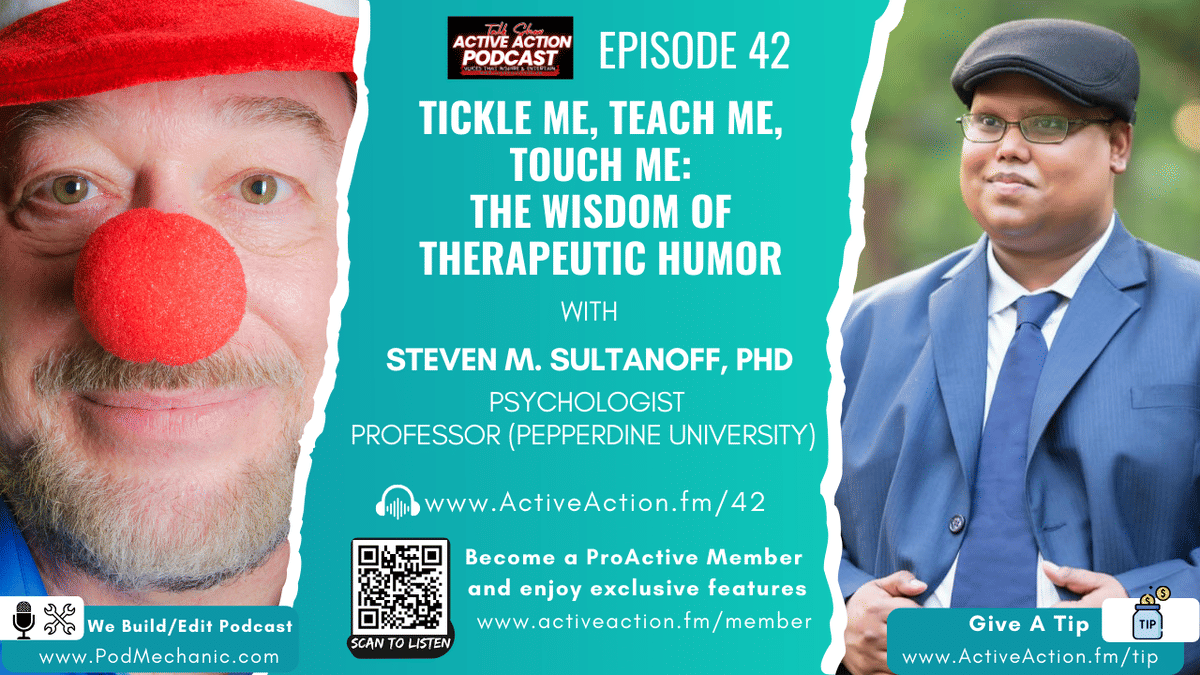
Humor is one of those things people often treat as “extra.” Something you enjoy when life is going well, and something you put aside when life gets stressful. But in this episode of the Active Action Podcast, the conversation flips that idea on its head.
Dr. Nazif sits down with Dr. Steve Sultanoff—a psychologist, professor at Pepperdine University, and a past president of the Association for Applied and Therapeutic Humor—to explore how humor can be more than entertainment. It can be a practical, intentional tool to support mental health, build resilience, and strengthen relationships.
The episode title says it beautifully: “Tickle Me, Teach Me, and Touch Me: The Wisdom of Therapeutic Humor.” And by the end of the discussion, it becomes clear that humor is not just about laughing. It’s about shifting the way we feel, the way we think, and the way we connect.
What “therapeutic humor” actually means
Dr. Sultanoff makes an important distinction right away. Humor in general can be helpful, but therapeutic humor is different because it is used intentionally and purposefully. In simple words, it’s humor used with a clear goal: to reduce distress, ease anxiety, help someone feel lighter emotionally, or offer a healthier perspective.
That also means therapeutic humor is not the same as telling jokes all session long. In Dr. Sultanoff’s clinical work, humor is blended into therapy as an intervention—subtle, well-timed, and supportive. Many clients don’t even realize it’s happening in the moment. They simply notice something powerful: they feel calmer, less tense, or more open to seeing their situation in a new way.
How Dr. Sultanoff entered the world of humor science
One of the most human moments in the episode is when Dr. Sultanoff says, honestly, that he wasn’t known as “the funniest guy.” He didn’t grow up as the class comedian. His journey into therapeutic humor started through curiosity.
At a major psychotherapy conference, he attended a panel on humor in therapy and noticed something surprising: there were many stories, but not much substance explaining why humor helps and how to use it responsibly in therapy. Later, at a laughter and play conference, he saw the opposite—people understood humor, but didn’t understand psychotherapy. That gap fascinated him.
Over time, he became known not for being the loudest comedian in the room, but for explaining the rationale, the mechanisms, and the healing foundation behind humor.
The four ways humor supports healing
One of the most valuable parts of the episode is Dr. Sultanoff’s explanation of the four main ways humor can support well-being. He describes humor as a trigger that activates multiple helpful processes in the mind and body.
1) Laughter: the physical response that supports the body
You’ve heard the saying “laughter is the best medicine,” and Dr. Sultanoff acknowledges that laughter really does carry physical benefits. Research has looked at things like reduced blood pressure, increased pain tolerance, changes in antibodies, and reduced stress hormones such as cortisol. In other words, laughter can help the body shift out of stress mode, even if only for a while.
2) Mirth: the emotional uplift
Dr. Sultanoff uses the word mirth to describe the emotional side of humor—joy, pleasure, lightness, uplift. When mirth shows up, distressing emotions like anxiety, anger, and sadness can lose their grip, at least temporarily. He explains it in a memorable way: mirth and distress don’t fully occupy the same emotional space at the same time. When you genuinely feel uplifted, emotional heaviness often loosens.
3) Wit: the mental shift and new perspective
This is where humor becomes deeply powerful for mental health. Wit is the cognitive component—the moment you “get it,” the moment your perspective shifts. Dr. Sultanoff gives the example of comics like Peanuts: you may not laugh out loud, but you understand something differently.
And that matters because our thoughts and interpretations are closely tied to our emotional distress. When humor gently changes how we think, it can also change how we feel.
4) Relational fusion: connection and bonding
Humor often happens between people. Even small moments of shared amusement can soften tension, strengthen bonds, and make relationships feel safer. Dr. Sultanoff describes this as humor acting like a social lubricant, making difficult conversations easier to receive and helping people feel connected instead of alone.
“Is there real evidence humor helps?”
Dr. Nazif asks the question many listeners are thinking: is humor truly supported by evidence, or is it just a nice idea?
Dr. Sultanoff explains that there is research behind humor’s benefits, including studies related to stress reduction, emotional well-being, and even some emerging findings around endorphins (the body’s feel-good chemicals). The episode also touches on how humor connects with gratitude, happiness, and reduced distress—especially when humor becomes part of daily life rather than a rare event.
The takeaway is not “humor fixes everything.” The takeaway is that humor can be a practical support—something that helps people regulate stress, feel more human, and recover perspective when life becomes heavy.
How to bring healthy humor into everyday life
This is where the episode becomes very usable. Dr. Sultanoff doesn’t talk about becoming a stand-up comedian. He talks about learning to invite humor into your normal routine.
He suggests creating a “humor happening” space in your mind—almost like building a small internal library of funny moments, playful ideas, and light memories you can pull from when you need them. Some people do this by writing down funny lines, saving clips, or keeping a small note in their phone.
He also suggests making humor easier to access by bringing it to you: subscribing to a daily joke list, watching sitcoms you genuinely enjoy, following comedians who lift your mood, or sharing something funny with a “humor buddy” each day.
And sometimes it’s even simpler than that—just noticing humor in the environment. He shares a childhood example of a street sign that read “Dead End” right in front of a graveyard, and how that small observation created a moment of laughter and bonding.
He also shares playful, real-life examples—like harmless little moments with servers at restaurants or bringing small lightness into everyday interactions. The point isn’t to perform. The point is to make life feel a bit more breathable.
Is all humor healthy?
This part of the conversation matters a lot.
Dr. Sultanoff is clear: not all humor is healthy. He describes three categories—healthy, hostile, and neutral humor—and explains that put-down humor and sarcasm that harms others can create distress, which goes against the whole purpose.
One simple test he offers is powerful: if you often have to say, “I was just kidding,” then the humor probably wasn’t kind. Healthy humor doesn’t leave people feeling small. It leaves them feeling lighter, safer, or more connected.
Want to connect with Dr. Steve Sultanoff?
Dr. Sultanoff shares ways listeners can learn more and reach him:
You can explore humormatters.com (spelled the American way: humor, not humour). It includes topical humor resources and information, with no ads or pop-ups.
You can also visit mycematters.com, which includes his articles and links to continuing education programs (especially helpful for therapists who want to learn how to integrate humor ethically into clinical work).
If you’d like to reach him directly, he shares an email for listeners: drsultanoff@humormatters.com.
And as Dr. Nazif mentions in the episode, listeners can also visit activeaction.fm and search Dr. Sultanoff’s name to find his bio and episode details.
Final reflection
This episode is a reminder that humor is not “childish,” “extra,” or “only for good days.” When used with care, humor can be a gentle form of strength. It can shift the nervous system, soften emotional pain, widen perspective, and bring people closer.
If life has felt heavy lately, you don’t have to force happiness. But you can give yourself permission to invite small moments of lightness back in. Sometimes, that’s not avoidance. Sometimes, that’s healing.
Thank you for listening, and if you found value in this conversation, please share the episode with someone who could use a little more relief and a little more joy.
Stay active and take action.
ChatGPT can make mistakes. Check i