
What would you do if you got a second chance at life — the second chance someone you loved never received?
That's the question Alan Lazaros has been answering for the past 11 years. And the way he's answered it has built a top 100 podcast, a seven-figure business, and a philosophy that's helping thousands of people rethink what success actually looks like.
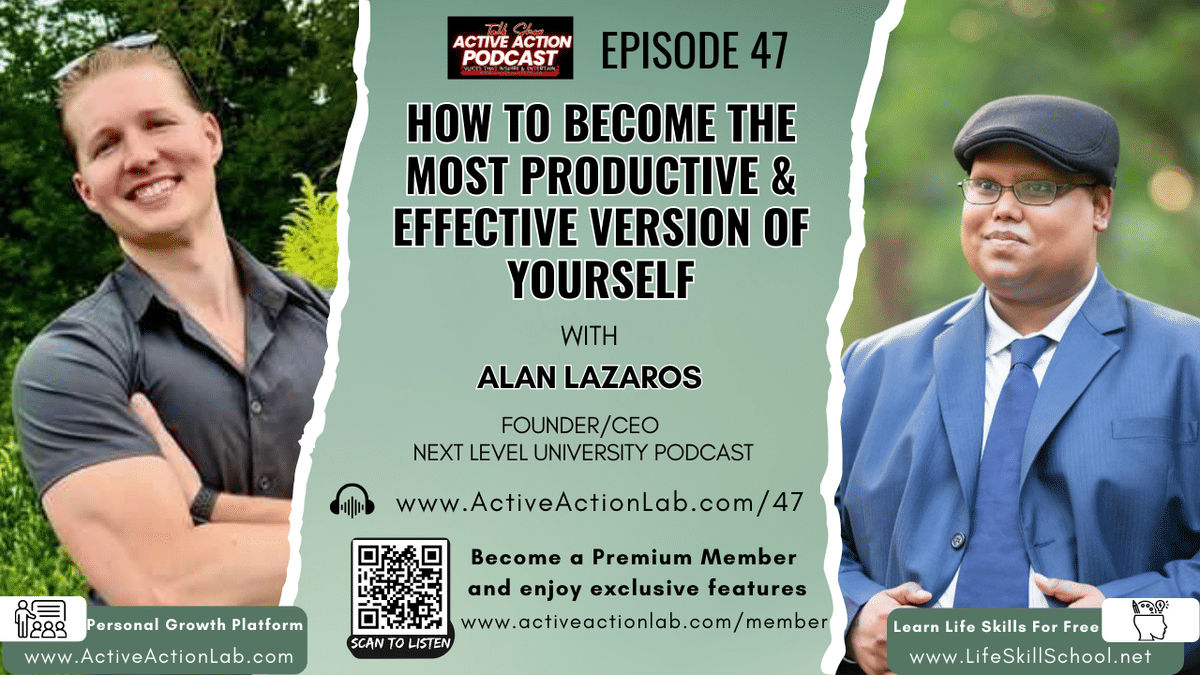
In this episode of the Active Action Podcast, Dr. Nazif sat down with Alan Lazaros, founder and CEO of Next Level University, to talk about productivity, holistic success, and the unglamorous but essential truth: self-improvement isn't sexy, but it's definitely valuable.
The Car Accident That Changed Everything
Alan's story doesn't start with a podcast. It starts with tragedy — and then a second brush with it.
When Alan was just two years old, his birth father died in a car accident at 28. Alan grew up without him, never knowing what could have been. Fast forward to age 26. Alan was living the traditional American dream. Computer engineering degree. Master's in business. Corporate job. Global top 1% earner making nearly $200,000 a year.
And then he got into a car accident.
"For me, this was sort of the second chance he never got," Alan explained. "And so I decided that day that I would reach my full potential."
That decision led him to personal development. It led him to start a company called Alan Lazaros LLC with a mission statement that still drives everything he does today: "What you'll never learn in school, but desperately need to know."
Because Alan had been a straight-A student. He attended some of the best colleges in the world. And yet, he never learned about productivity, habits, goal-setting, fitness, or practical finance — the fundamental skills that actually determine the quality of your life.
"It pissed me off," he said. "So I decided to try to be the change I wish to see in the world."
Eleven years later, Next Level University has published 2,300 episodes, employs a 23-person team, coaches 26 individuals in business, serves 126 paying clients, and produces 86 podcasts. But the mission hasn't changed. It's still about sharing what schools don't teach — and doing it in a way that actually works.
The Trifecta of Success: Health, Wealth, and Love
One of the most distinctive parts of Alan's philosophy is his refusal to specialize in just one area of life. While most coaches focus on either fitness, or business, or relationships, Alan takes a holistic approach.
"I didn't want to be healthy and wealthy but not in love," he explained. "I didn't want to be healthy and in love but not wealthy. And I didn't want to be wealthy and in love but not healthy."
To Alan, the trifecta of success is health, wealth, and love:
Health is physical, emotional, and spiritual well-being.
Wealth is about meaningful work, earning potential, and investing (not spending).
Love is your intimate relationship, family, friends, colleagues, clients, mentors, and team.
If you're thriving in all three areas, you're successful. Not just externally successful — genuinely successful.
But here's the challenge: statistically, if you're in the top 1% in health, top 1% in wealth, and top 1% in love, you're actually one in a million mathematically. And that's not hyperbole — it's 1/100 × 1/100 × 1/100.
"That's three full-time jobs right there," Alan said. "And I say I want to be one in a million. I do. And I will dedicate my existence to that."
This philosophy is what separates Alan from the "get rich quick" crowd or the "hustle culture" gurus who burn out by 30. He's playing a different game — one that requires patience, discipline, and an honest reckoning with what success actually means.
The 1% Philosophy: Small Actions, Massive Results
If you've been in the personal development space for any length of time, you've probably heard some version of the "1% better each day" concept. But Alan doesn't just talk about it — he's built his entire business model around it.
"If you get 1% better every single day for a year, you'll be 37 times better at the end of the year," he explained. "If you get 1% worse every single day for a year, you'll be 97% worse at the end of the year."
The math is startling. It's the compound effect in action. But what makes Alan's approach different is his emphasis on sustainability over intensity.
"I would rather you work out a half an hour a day for 18 days straight than nine hours on one day," he said.
This is where most people go wrong. They set massive goals, overcommit, burn out, and quit. They confuse motivation with discipline. They mistake intensity for consistency.
Alan's advice? No deviation from the mean. Stay the course. Be the unrelenting tortoise that just keeps going every single day, a little bit at a time.
Why Self-Improvement Is Everything
When Dr. Nazif asked why self-improvement is so critical to success, Alan quoted legendary personal development speaker Jim Rohn:
"Trying to have an above-average income and an above-average life while trying to stay an average person is very frustrating."
The point is simple but profound: you take yourself with you everywhere you go. You can't change your circumstances, your family, or where you were born. But when you change yourself, when you improve yourself, you change every room you enter.
Alan offered a powerful metaphor to drive this home:
"If someone wins a million dollars in the lottery but never learned or developed the skills to earn the million dollars, they're going to lose it."
It's why so many lottery winners end up broke — or even worse off than before. They climbed the mountain without building the capacity to stay at the top. They got the result without developing the character, skills, mindset, and belief systems necessary to sustain it.
"Real success with real people in the real world comes from the inside out," Alan said. "Trying to have an extraordinary life without becoming an extraordinary person is unintelligent and undoable."
This isn't just motivational fluff. It's a structural argument for why self-improvement isn't optional. If you want lasting success — the kind that doesn't crumble the moment adversity hits — you have to build it from the inside out.
How to Handle Overwhelm Without Crumbling
With all that Alan has going on — coaching clients, running a podcast empire, producing content, managing a team — Dr. Nazif asked the question everyone wants to know: How do you stay aligned without being overwhelmed?
Alan's answer was both honest and clarifying:
"I think in some ways, I'm always a little overwhelmed. The difference is, life doesn't get easier — you handle hard better."
He used a basketball metaphor to illustrate the point. When you're playing against little kids in middle school, you can be pretty good with minimal talent. But as you move up — high school, college, D3, D2, D1, the NBA — you're playing against better and better competition.
"Life does not get easier when you succeed. Success makes life harder, not easier. You just handle it better than you used to."
So how does Alan continuously level up without breaking?
He focuses on building capacity gradually. The goal is to max out your current capabilities, grow, max out again, grow, and repeat — but with strategic recovery periods in between.
"If you max out, max out, max out, max out, you basically crumble," he said. "You need some time to stretch the balloon without it popping."
Alan sets goals that require skills and capacity just beyond his current level. When he's at level one, he shoots for level two. When he reaches level two, he enjoys it for a moment, then sets his sights on level three — always learning the capabilities he'll need before he actually needs them.
"I'm taking a course right now on enterprise building that I won't need for a decade," he shared. "But I'm always preparing in advance for the next battle."
This is proactive growth versus reactive growth. It's the difference between building resilience before the storm versus scrambling when it hits.
Two Types of Adversity
Alan made a critical distinction between two types of adversity:
Random adversity — things life throws at you that you can't control (his father's death, his stepdad leaving).
Inevitable adversity — challenges that come as a byproduct of pursuing meaningful goals.
"If you aren't setting goals that challenge you, life is going to throw something at you and you're going to crumble," he said.
His philosophy? Prepare in advance. Train for the worst. Become the kind of person who doesn't fold when hard things happen — because hard things will happen.
"Life is unfathomably challenging. And people don't talk about it enough, especially in the 21st century. I'm always preparing in advance for the next atrocity that life is gonna throw my way."
It's not pessimism. It's realism. And it's what separates people who rise to the occasion from people who fold like origami.
Final Thoughts
Alan Lazaros is selling kale outside a candy store. Personal development isn't flashy. It's not as sexy as quick wins or get-rich-quick schemes. But it's valuable — and it's the only thing that lasts.
His mission is simple: teach people what schools never do. Help them become 1% better every single day. Build health, wealth, and love in equal measure. Prepare in advance for adversity. Handle hard better.
Because trying to have an extraordinary life without becoming an extraordinary person? That's not a strategy. That's a recipe for frustration.
If you want to connect with Alan, visit www.nextleveluniverse.com or DM him on Instagram (yes, it's actually him — not a bot). And if you want to hear 2,300 episodes of practical wisdom, check out the Next Level University podcast.
Enjoyed this episode? Subscribe to the Active Action Podcast for more conversations on productivity, resilience, and intentional living. And share this episode with someone who's ready to stop chasing shortcuts and start building real, sustainable success.