
There are guests who bring stories, and then there are guests who bring a whole world with them—hard-earned lessons, real pressure-tested leadership, and the kind of honesty that makes you pause and reflect on your own life.
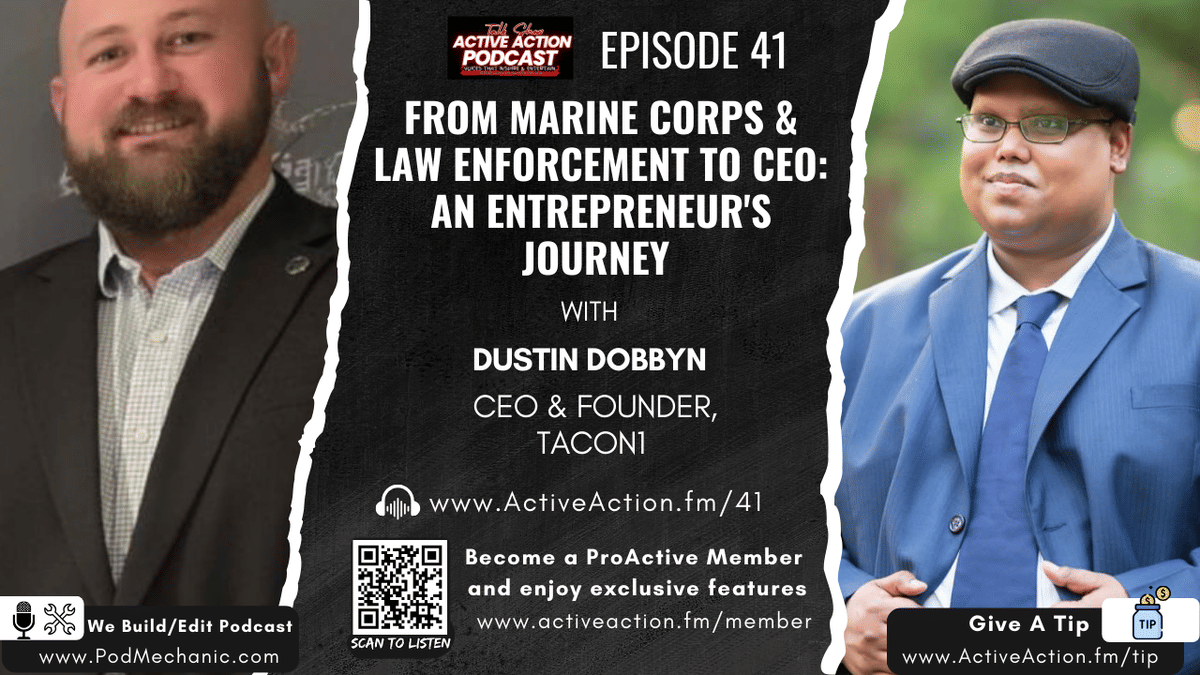
In a recent episode of the Active Action Podcast, I sat down with Dustin Dobbyn, CEO and founder of TACON1, a rapidly growing high-risk security and executive protection firm based in Colorado. Dustin is a U.S. Marine Corps veteran, a former SWAT operator, and an internationally recognized security professional whose career has included everything from counterterrorism-focused deployments to violent crime investigations and frontline law enforcement work.
But what made this conversation special wasn’t only the intensity of his background. It was how clearly he spoke about something many people quietly struggle with: pressure builds up, and if we don’t learn how to release it, it eventually spills over—no matter how strong we look from the outside.
A tough start, and a decision at 17
Dustin shared that his childhood wasn’t easy, and that life circumstances pushed him to make grown-up decisions early. At 17, he chose to join the Marine Corps—a choice influenced by family role models, including a stepfather who served in Vietnam and carried the kind of discipline that shaped the household. He also had people around him who believed in the Marines as the highest standard, and that belief mattered when it came time to choose a path.
For many listeners, that moment is relatable, even if the military world isn’t. Sometimes life forces a decision: keep drifting, or choose structure.
What the Marine Corps taught him that movies never show
Many of us only “know” military life through movies and TV shows. Dustin offered something better than entertainment: a grounded, lived perspective.
He explained how his role evolved quickly. After switching to an open contract to support his growing family, he found himself in infantry, then part of FAST (Fleet Anti-Terrorism Security Team), training for and deploying into high-risk environments. Later, he fulfilled an infantry obligation and deployed to Afghanistan.
When I asked about Afghanistan, he didn’t dramatize it. He described it as a mix of good and bad days—but he was clear about his biggest takeaway: leadership. The kind of leadership that stays with you for life. The kind you still talk to years later.
And that theme kept returning throughout the interview: strong leadership shapes people—and it shapes how they handle pressure.
Leaving service: when family and reality pull you home
Dustin also spoke openly about the cost of service, especially during wartime. He completed four deployments in almost six years. Even when he wasn’t deployed, he was training to deploy. Time at home could feel like a short pause, not a full return.
Like many veterans, he reached a point where family needs, personal realities, and career limitations all collided. When the military downsized and options narrowed, he transitioned into a new chapter: law enforcement.
From prison work to gangs, SWAT, and investigations
His law enforcement story didn’t begin with patrol—it began in a prison environment, where he learned how complex and heavy that world can be. He described it honestly: it takes a special kind of person to thrive there, and he respects those who do it.
Eventually, he entered the police academy, graduated at the top of his class, and jumped into high-intensity roles. He worked the street, joined gang units, handled investigations, and later became part of a SWAT team. He described his younger self with a mix of humour and humility—ambitious, determined, and eager to do everything at once.
Then came a period that pushed many people to the edge: COVID-era stress. Dustin explained how pressure in communities rose, and how violent incidents increased as people struggled with lockdowns, fear, and instability.
One of the most interesting parts of the conversation was his self-awareness. He said he often stayed calm in chaos—because that’s what he was trained for. The real danger wasn’t always the moment of action. The danger was what happened when things got quiet and there was too much time to think.
That’s something many listeners will recognize, even outside law enforcement. Sometimes it’s not the busiest day that breaks you. It’s the day you finally stop moving and everything catches up.
Burnout isn’t weakness—it’s physics
Dustin used a simple image that hit hard: your cup fills slowly, and if you don’t drain it, eventually it overflows.
He shared that he reached a breaking point—what he described as a mental collapse—and he needed to step away to get his head right. What helped him was realizing he wasn’t alone. Even leaders he admired—people he thought were indestructible—had faced similar breakdowns.
That realization can be life-changing: if strong people can struggle, struggling doesn’t mean you are weak. It means you are human.
His advice was clear and compassionate in its own way:
Take a step back. Reassess. Then move forward in the most strategic way for you. That might mean changing careers, taking a break, or rebuilding your routine and support system.
And above all, he reminded listeners that your story is not over unless you decide it is.
TACON1: why he built a different kind of security company
After stepping away from law enforcement and later moving to Colorado, Dustin returned to the private security space. He worked with many companies and held leadership roles, but he kept noticing a pattern: too many companies treated people like disposable labour. Training was often minimal—just enough to meet licensing requirements—and in some cases, corners were being cut.
That didn’t sit right with him.
He originally launched TACON1 as a tactical training company, but client demand quickly expanded. People didn’t just want training—they wanted a team they could trust. Over time, TACON1 grew into a full-service security organization offering:
Unarmed and armed security, security patrols, executive/close protection, secure transports for high-value items and people, and specialized services for high-risk environments. Dustin also shared that TACON1 is developing a “ghost team” concept for global high-risk operational deployments.
What makes his approach different is how he described the company’s culture:
TACON1 vets its team members carefully, invests in training, and builds services around what clients actually need. He gave an example of customizing uniforms and operations so security teams feel integrated—embedded—rather than like outsiders standing at the edge.
That word “team” came up again and again. For Dustin, the best part of both the Marines and law enforcement was camaraderie. Now he’s trying to rebuild that same standard in the private sector.
Training that’s tailored, not generic
Another standout piece of the conversation was the way Dustin spoke about training. He explained that TACON1 can train individuals or organizations and tailor programs based on specific needs—whether it’s licensing requirements, professional development, or specialized safety skills.
He also emphasized that training shouldn’t feel like “just getting a piece of paper.” People should walk away feeling they truly earned something and improved.
That mindset—respecting the learner, respecting the craft—is what separates a serious organization from a checkbox service.
A book built from real life: Perseverance: The Operator’s Mindset
Near the end of the episode, Dustin shared that he recently published a book titled Perseverance: The Operator’s Mindset. It’s a memoir that traces his journey from childhood through the military, law enforcement, breakdown, recovery, and ultimately building TACON1.
What stood out was the purpose behind it. He wants readers—especially those facing setbacks—to feel less alone, and to see that rebuilding is possible.
Sometimes the most powerful leadership isn’t the “never fall” story. It’s the “I fell, and I learned how to stand up again” story.
Final reflection: strength is also knowing when to pause
This conversation wasn’t only about tactical experience or high-risk careers. At its heart, it was about resilience, identity, and mental wellbeing.
If you’re someone who keeps pushing, keeps performing, keeps carrying responsibility—please hear this part clearly: you deserve moments to breathe. You deserve support. You deserve a life that doesn’t require breaking down before you start healing.
Dustin’s message landed because it was simple and real: you’re in charge of your story. Nothing is finished until you decide it is.