

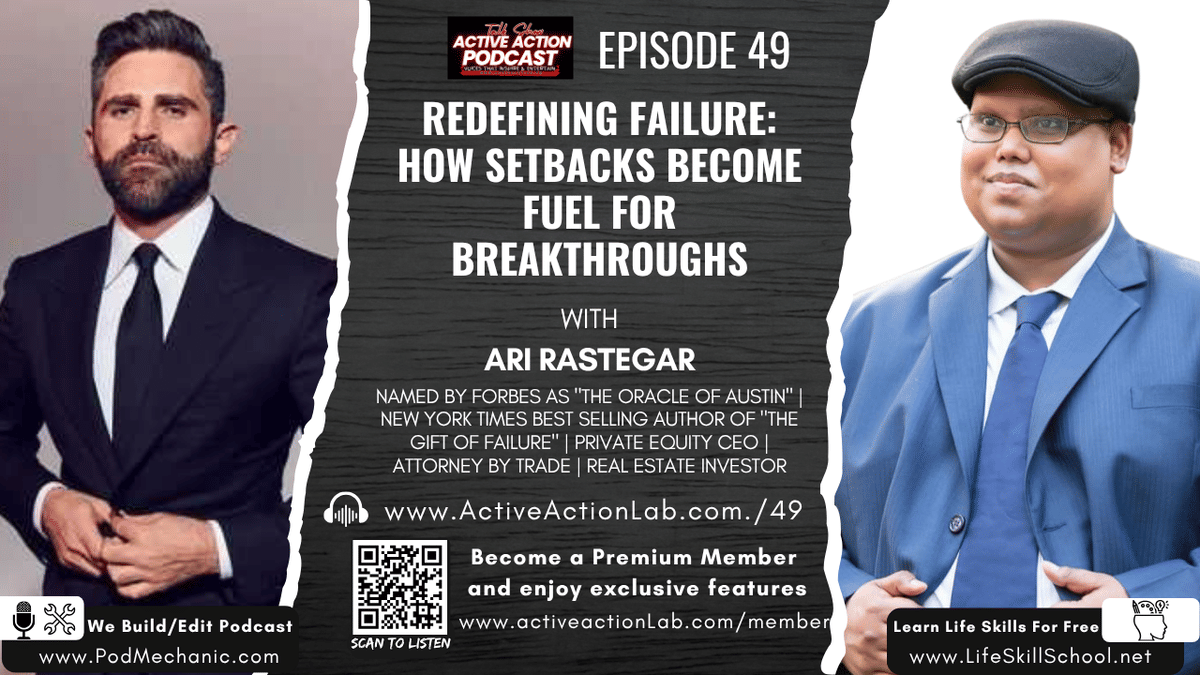
Most success stories skip the hard part. They jump from the humble beginning straight to the highlight reel — the deals closed, the empires built, the followers earned. What gets edited out is the middle: the failures, the dark nights, the moments when everything falls apart.
In our latest episode of the Active Action Podcast, Ari Rastegar refused to skip that part. And what he shared might be the most honest conversation about success we've hosted yet.
The Man Behind the Empire
Ari Rastegar is the founder and CEO of Rastegar Capital, a real estate investment firm managing a multi-billion dollar portfolio. He's an author, an entrepreneur, and a creator with more than 750,000 followers across his platforms. By any external measure, he has arrived.
But his story didn't begin with capital. It began with a $3,500 loan he took out as a law student — and a long, painful education in what it actually takes to build something that lasts.
"I Hope You Fail. I Hope You Fail a Lot."
That's the first line of Ari's book, The Gift of Failure. And in our conversation, he doubled down on it.
"The only true failure is quitting," he told us. "Otherwise, it's not failure — it's temporary defeat."
His reframe is striking: failure isn't the opposite of success. It's the process of success. The greatest achievers in the world fail more, not less. The difference is that they keep going — and crucially, they pause long enough to learn.
This is where Ari's advice diverges from the usual "get back up" cliché. He doesn't want you to spring back to your feet immediately. He wants you to lie there for a while.
"Don't get up so quickly. Lay there. Think about what went wrong, what went right. Trace your steps. The best athletes in the world watch hours of film. You should do the same with your life."
Failure is only a gift, he reminded us, if you actually look back and learn from it.
The Pressure Principle
If failure is the curriculum, pressure is the classroom.
"Whenever you're after something bigger than you, you have to grow. And growth requires pressure. If you want bigger muscles, you push pressure. If a coal is going to become a diamond, it requires pressure. The universal truth of any kind of growth is pressure."
The skill, then, isn't avoiding pressure — it's staying calm inside it. For Ari, that means meditation. He's spent significant time studying with Dr. Joe Dispenza, exploring the neuroscience of how a coherent heart and a coherent mind create a coherent life.
His point applies whether you run a billion-dollar firm or a small household: starting your day in a state of reactivity — phone in hand, kids needing breakfast, emails firing — is no foundation for the kind of thoughtful, patient, tactical life you actually want to build. Even five minutes of stillness can change the texture of everything that follows.
The Hardest Promise You'll Ever Keep
One of the most quotable moments of the conversation came when we asked about transparency. Ari reframed the entire concept:
"Transparency is a promise. And first, keep the promises you make to yourself."
He walked us through the analogy: imagine a friend agrees to meet you at the gym at 8 AM, doesn't show, apologizes, promises again — and doesn't show again. You'd stop trusting them. Yet most of us treat ourselves exactly that way every single day. We promise to start the diet, to hit the gym, to write the chapter — and we break those promises constantly.
Each broken promise to yourself, Ari argues, is a withdrawal from your personal integrity account. And without personal integrity, vulnerability becomes impossible. You can't be transparent with others when you're not even transparent with yourself.
"True power lies in vulnerability, not in hiding. But only people who have earned personal integrity through promises kept to themselves can actually access it."
Pain Is Real. Suffering Is a Choice.
Ari shared a story from Tony Robbins' interview with Nelson Mandela. After 30 years in prison, Robbins asked him how he survived. Mandela's answer:
"Survive? I didn't survive. I prepared."
For Ari, this captures the essence of ownership. Life isn't fair — it never was, never will be. Things will happen that aren't your fault. But, as he put it: "It still might be your responsibility. And if it's not your responsibility, that means you don't have control. And if you don't have control, you don't have anything."
He drew a careful distinction between pain and suffering. Pain is what happens to you. Suffering is the story you tell about it. There are people in genuine, inescapable pain — and Ari was clear that this framework doesn't apply to them. But if you're privileged enough to be reading this on a screen, with your faculties intact, the choice is available to you.
A Tale of Two Disasters in One Week
The episode's most jaw-dropping story came near the end, when we asked Ari which setback he was most grateful for.
In his twenties, Ari built a massive entertainment company. He signed the Black Eyed Peas to perform at a Super Bowl event in Dallas. Sports Illustrated sponsored it. Tables sold for $50,000.
Then the biggest ice storm in Dallas history hit — and destroyed the profitability of the entire production.
The very next week, he was set to host a Snoop Dogg performance at the Playboy Mansion for NBA All-Star weekend. (He'd won the venue in a poker match against Hugh Hefner — a story unto itself.) Then a Legionnaires' disease outbreak shut the mansion down. The party was canceled.
"I went to sleep a millionaire and woke up broke," Ari told us. "I was a millionaire for about seven or eight hours."
That double catastrophe taught him something that would later define his entire investment philosophy: focus on the downside, not the upside. Manage risk. Build hedges. Plan for the unplanned. Today, he manages capital that belongs to firefighters, teachers, and hardworking families — and he says he's grateful he learned that lesson when the stakes were small instead of when billions of other people's dollars were on the line.
What Winning Looks Like Now
Early in his career, Ari measured winning in deals closed and dollars earned. Today, his definition has shifted.
"Winning now is having control over how I feel. If I kept my mind and my heart centered around my blessings, around gratitude, around joy — I won the day. Because it's always a choice. You can focus on what's wrong, or you can focus on what's right. They're both available."
That, perhaps, is the deepest takeaway from this conversation. The empire, the followers, the portfolio — those are outputs. The real work is internal: keeping promises to yourself, taking responsibility, staying coherent under pressure, and choosing — every day — what to focus on.
Listen to the Full Episode
This blog only scratches the surface of an hour-long conversation packed with hard-won wisdom. Ari speaks with the unguarded clarity of someone who has truly been through it — and you can hear it in every answer.
🎧 Listen to the full episode on the Active Action Podcast — available on Spotify, Apple Podcasts, and YouTube.
📚 Pick up Ari's book, The Gift of Failure, on Amazon or Audible.
🌐 Learn more about Ari's work at Rastegar Capital.