
Leadership is often portrayed as something you earn through titles, authority, or the number of people who report to you. But what if the truest form of leadership has nothing to do with any of that — and everything to do with how you lead your own life?
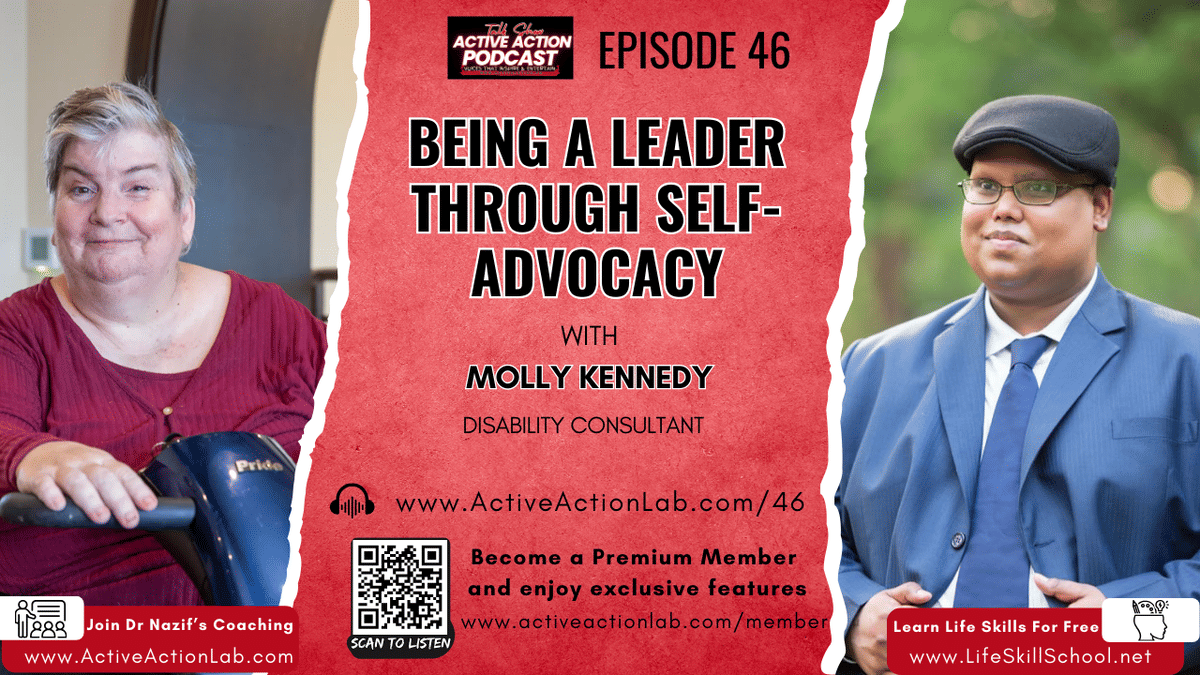
That's the question at the heart of our latest conversation on the Active Action Podcast, where Dr. Nazif sat down with Molly Kennedy — disability consultant, self-advocate, nonprofit founder, and one of the most quietly powerful voices in the self-determination space.
Who Is Molly Kennedy?
Molly was born with cerebral palsy in California, the youngest of seven siblings in a large Catholic Irish family. Her parents — a doctor and a nurse — made an early decision that would shape everything: they would raise Molly just like her brothers and sisters. No special treatment, no lowered expectations. Just: try your best, and you will succeed.
She attended private Catholic schools from first grade through college graduation, often as the only student with a disability her school had ever enrolled. She went on to earn her bachelor's and master's degrees, built an 18-year career in the Bay Area, and eventually founded Molly Kennedy Consulting, where she now works to help people with disabilities live self-determined lives.
Her story is not one of overnight triumph. It's something better — a steady, deliberate, courageous insistence on showing up fully, no matter the obstacle.
The Moment Self-Advocacy Changed Everything
When asked about a defining moment when standing up for herself changed the direction of her life, Molly pointed to a decision she made as a high school senior. While her parents assumed she would attend a nearby university or community college, Molly had a different vision — she wanted to go away to college.
"I advocated that this is what I needed to do," she said. "I needed to get a college degree, but just as important — I needed to learn to be on my own and to be independent."
It wasn't a grand speech or a dramatic confrontation. It was simply Molly naming what she needed and refusing to shrink from it. That act of self-advocacy opened the door to a life she built entirely on her own terms.
The lesson here is transferable to anyone, disability or not: there are moments in life when you must articulate your own needs clearly — to a parent, a manager, a partner, or a system — and those moments, as uncomfortable as they feel, are often the ones that redirect your entire trajectory.
Confidence Is Built, Not Given
One of the most grounding parts of Molly's conversation was her honest take on confidence. She didn't describe it as something she was born with or simply chose to have. She built it — systematically, through goal-setting and follow-through.
"I had to build confidence by setting goals and achieving those goals," she explained. "Graduating from college, getting a job, getting my master's degree — all of this kept confidence in me."
For people with disabilities especially, Molly noted, confidence requires an extra layer of determination because the world often responds to how you look or how you speak before it acknowledges what you know or what you're capable of. Proving those assumptions wrong, again and again, is both exhausting and empowering.
This is a framework worth borrowing: confidence is the compound interest of small wins. Every goal you set and achieve — no matter how modest — deposits something into your belief in yourself. Over time, that account grows.
Leadership Starts With Leading Your Own Life
When Dr. Nazif asked Molly how she defines leadership, her answer cut straight to the core.
"For me to be a leader, I have to be a leader of my own life," she said. "Dreams don't work unless you put together a plan — goals, problem-solving, decision-making. You first have to have the ability to lead your life and be in control of it."
This is a distinction that often gets lost in conversations about leadership. We look outward — toward influence, followers, visibility — when the real work is internal. Molly's brand of leadership is about self-mastery: knowing what you want, making a plan, taking responsibility for your choices, and refusing to let others define the boundaries of your life.
For people with disabilities, she acknowledged, this is especially challenging because a well-meaning world often defaults to caretaking rather than empowering. Learning to assert your own agency in the face of that — to say I can do this when others assume you can't — is its own form of leadership.
Turning Setbacks Into Strength
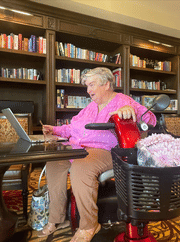
Perhaps the most moving part of Molly's story was her account of losing her ability to walk ten years ago. This was not a small setback. She had been living independently, and now she needed to move into a senior community for support. By any measure, this was a profound loss.
And yet, Molly's response was characteristically clear-eyed.
"You just got to reframe who you are and still keep what deeply matters to you," she said. "Just because I couldn't walk doesn't mean I can't be involved in my community."
She started a nonprofit.
Her advice for navigating setbacks is practical and human: take a break, breathe, assess the situation honestly, and then start building a way forward. Not because it's easy, but because the alternative — letting the setback become the final word on your life — is simply not acceptable.
She summed it up with a line that stopped the conversation in its tracks:
"It's not what I overcome — it's what I become."
That reframe is everything. The goal isn't to erase hardship from your story. It's to let hardship shape you into someone more resilient, more purposeful, and more capable of helping others who are walking the same difficult road.
Everyone Has the Right to Dream
When Dr. Nazif asked what she would say to someone who feels their disability limits their ability to dream big, Molly didn't flinch.
"Everyone has the right to dream and imagine how they'd like their life to be — and that's no different for people with disabilities," she said. "We're not different. We just have a disability. But that shouldn't stop us from dreaming and having an impactful life."
It was a simple statement, but one that carries enormous weight in a culture that too often conflates limitation with impossibility. Having a disability may mean navigating a different path. It does not mean the destination is out of reach.
Molly's Work Today
Through Molly Kennedy Consulting, Molly is channeling all of this lived wisdom into tangible programs. She's currently developing a curriculum focused on self-determination for youth with disabilities — helping young people understand that even when they require support, they still hold the authority to define their own goals, dreams, and futures.
She also speaks at conferences and works one-on-one with individuals to help them understand how self-determination can practically improve their lives.
If you want to learn more about Molly's work or connect with her consulting services, visit www.mollytkennedy.com.
Final Thoughts
Molly Kennedy's story is not just for people with disabilities. It's for anyone who has been underestimated, anyone who has faced a loss they didn't expect, and anyone trying to figure out what leadership actually looks like when it isn't handed to you.
The answer, it turns out, starts with a single, radical act: deciding to lead your own life — with honesty, with plans, with resilience, and with the unshakeable belief that you have the right to pursue the life you want.
That's what self-advocacy looks like. And that, as Molly shows us, is where real leadership begins.
Enjoyed this episode? Subscribe to the Active Action Podcast for more conversations on leadership, resilience, and intentional living. And share this episode with someone who needs to hear it today.